
Skip to content
Search

Latest Stories

India's Adani Ports reports 76 per cent profit surge in Q4

In its fiscal year 2023-24, Adani Ports accounted for over a quarter of India’s cargo volumes, surpassing projections by handling 420 MMT cargo.

India's Adani Ports reports 76 per cent profit surge in Q4

India's Adani Ports and Special Economic Zone (APSEZ), the country's top private port operator, announced a 76 per cent surge in its fourth-quarter earnings, credited to unprecedented cargo volumes.

The company, led by billionaire Gautam Adani, disclosed that its net profit climbed to £195.21 million in the quarter ending March 31, compared to £110.78 million a year earlier.


Recording its highest quarterly volumes at 109 million metric tonnes (MMT) during January-March, APSEZ saw a 19 per cent uptick in revenue to £658.98 million, as business momentum gained in early 2024.

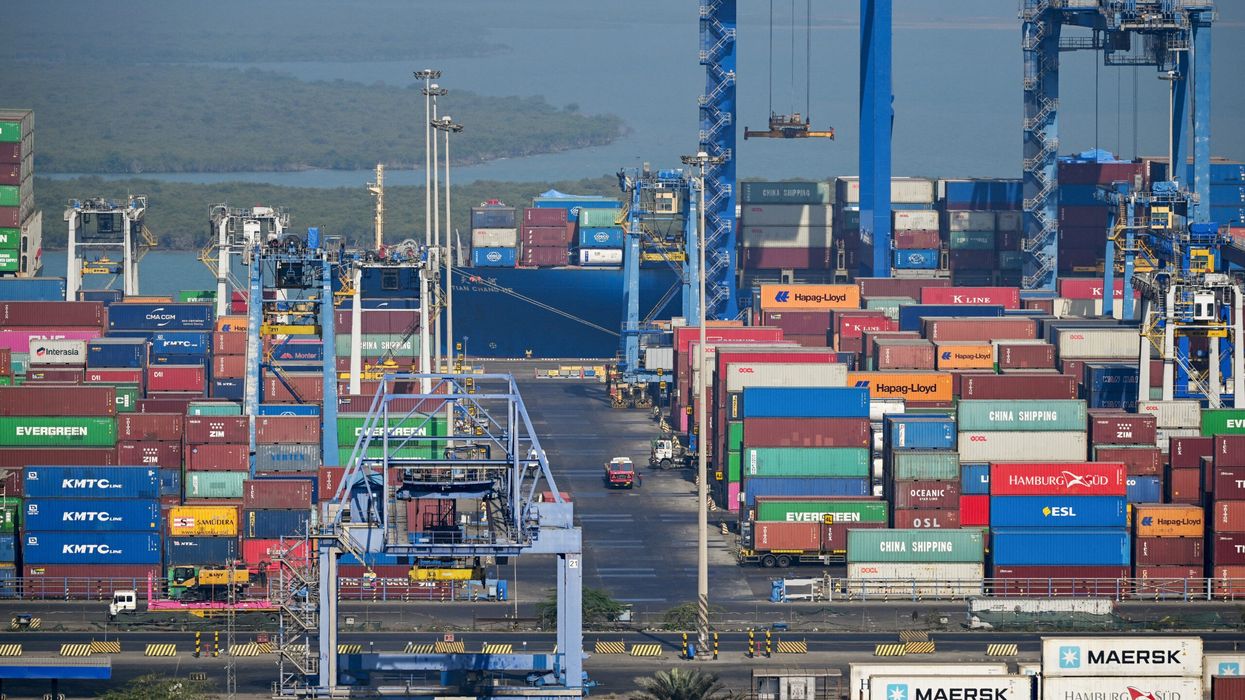
Operating 13 ports and terminals across India, including Mundra, the nation's prime container handling port situated in Gujarat, APSEZ asserted its crucial role in the country's maritime trade.

In its fiscal year 2023-24, APSEZ accounted for over a quarter of India's cargo volumes, surpassing projections by handling 420 MMT cargo.

Signifying its expansion drive, the company disclosed plans to acquire a 95 per cent stake in Odisha's Gopalpur Port for £155.09 million, aiming to bolster its presence on the east coast.

Following the earnings report, APSEZ's stock surged by 1.5 per cent. Year-to-date, the stock has escalated by approximately 31 per cent, outpacing the benchmark Nifty 50 index's 4.5 per cent growth.

(Reuters)

More For You

British Steel nationalisation

The UK government is expected to announce full British Steel nationalisation in the king’s speech

Getty Images

Why the UK government is moving to fully nationalise British Steel after years of crisis

  • The UK government is expected to announce full British Steel nationalisation in the king’s speech.
  • British Steel’s Scunthorpe plant operates the country’s last remaining blast furnaces.
  • Rising losses, Chinese ownership tensions and fears over industrial security pushed the government towards intervention.

For decades, the giant blast furnaces towering over Scunthorpe stood as symbols of Britain’s industrial strength. Now, they are becoming symbols of something else entirely — the struggle to keep the country’s steel industry alive in a rapidly changing global economy.

The UK government is expected to formally move towards full nationalisation of British Steel in the upcoming king’s speech, marking another dramatic turn in the long and turbulent history of one of Britain’s most politically sensitive industrial businesses.

Keep ReadingShow less