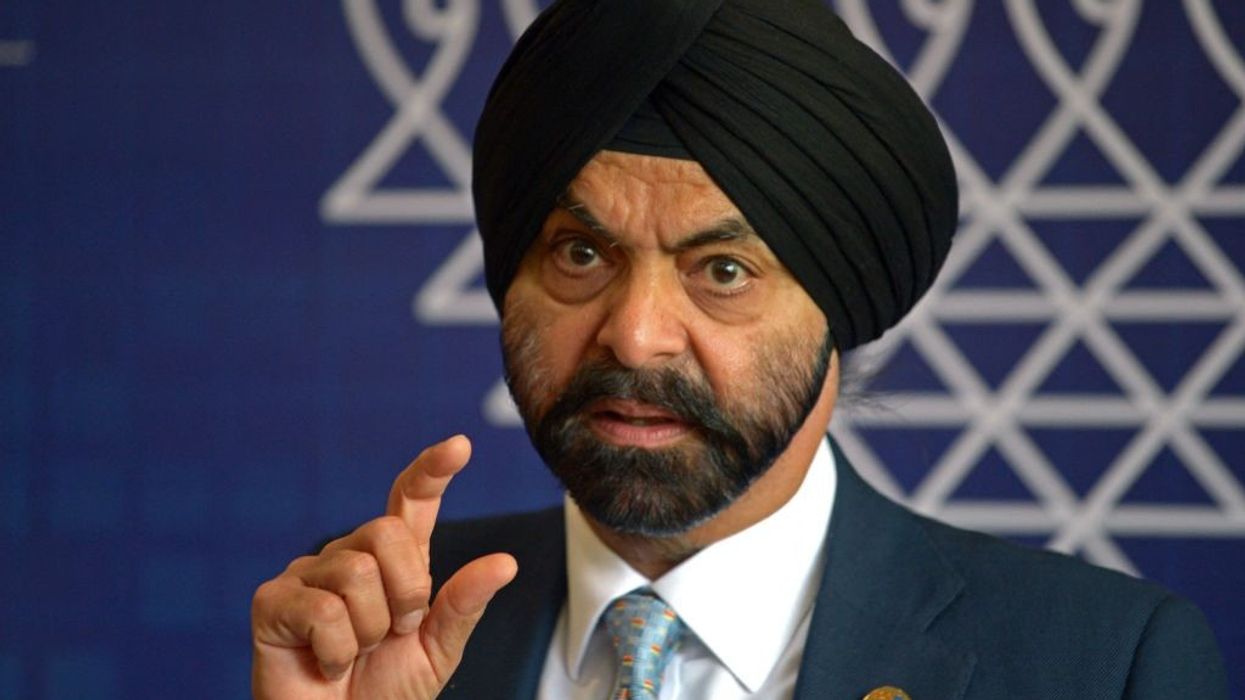

The new head of the World Bank said Tuesday (18) that growing divides between rich and poor nations risked deepening poverty in the developing world.
Ajay Banga said he feared a lack of progress was in danger of splitting the global economy.
"The thing that keeps me up at night is a mistrust that is quietly pulling the Global North and South apart at a time when we need to be uniting," Banga told the two-day meeting of finance ministers and central bank chiefs in Gandhinagar, Gujarat.
"The Global South's frustration is understandable. In many ways they are paying the price for our prosperity," said Indian-born Banga, a naturalised American citizen who took up the bank post last month after being nominated by US President Joe Biden.
"When they should be ascendant, they're concerned promised resources will be diverted to Ukraine's reconstruction, they feel energy rules aren't applied evenly, constraining ambition, and they're worried the grip of poverty will pull down another generation."
Banga said that developing nations had the highest percentage of young people, but that was only an opportunity if they can access education and find employment.
"If they don't... that is not a demographic dividend, that is a challenge to countries", he said.
The World Bank said it is working to increase its financial capability -- including by raising hybrid capital from shareholders -- to spur growth and jobs, but said the future economy could not rely on expansion at the cost of the environment.
"The simple truth is: We cannot endure another period of emission-intensive growth," Banga said.
'More optimistic about India'
Banga said that amid global challenges, he is more optimistic about India and its economy now than he has been "in a long time". He added that the world economy is in a difficult place.
The World Bank chief showered praises on India for its digital infrastructure, saying he is a "big fan" of such initiatives taken by the world's fifth largest economy.
"I am more optimistic about India, as a whole, economically, than I have been for a long time. The fact is that the world economy is in a difficult place. It has outperformed what everybody thought. But it does not mean that it won't be more challenging. The IMF forecast, the World Bank forecast are that the world will get a little challenging over the next year or so," he said.
Praising India for the steps taken in recent times to build digital infrastructure, he said applications which were built around that framework are making people's lives easier today.
Debt restructuring deals for low-income nations have been a key focus of The Group of 20 major economies.
"The debt challenge is the single biggest challenge," Banga said.
China, the world's second-largest economy and a major lender to several stressed, low-income countries in Asia and Africa, has so far resisted any one-size-fits-all debt restructuring formula.
The G20 talks have also focused on multilateral development banks' reform, cryptocurrency regulations, and easier access to financing to mitigate and adapt to the impact of climate change.
(Agencies)