PORTLAND this weekend marks 100 days since protests erupted in the western US city to denounce police brutality and racism, shining a spotlight on a deeply polarised America as it prepares for high-stakes elections.
The nightly protests, sparked by the death of George Floyd while in police custody in Minneapolis in May, escalated sharply in the Oregon city after the Trump administration deployed federal agents to protect federal property from damage.
Floyd's death triggered similar protests nationwide, but it is in Portland -- a city of 650,000 that is more than 70 percent white -- that activists have remained on the streets practically every night, demanding racial justice and police accountability.
"If we want to change the system, refuse this systematic racism, we need to keep on saying it in the streets at least until the election," a demonstrator who would only identify himself by the letter S, the first initial of his given name, told AFP.
He accused President Donald Trump of inflaming racial tensions, saying "the country has never been so divided."
Although the demonstrations toned down after federal agents withdrew at the end of July, tensions escalated again last weekend after a man identified as a supporter of a right-wing group was shot and killed.
Trump has cast the city as being under siege by "thugs" engaged in "domestic terrorism," even though the demonstrations have been peaceful for the most part.
He has also warned that should his Democratic rival Joe Biden win the election in November, cities like Portland will fall into chaos across America.
But that's not how activists in Portland see things.
"We're not trying to burn stuff down," Reese Monson, 30, a local Black Lives Matter leader, told AFP this week on the sidelines of a protest near a police station.
As he spoke, a few dozen black-clad protesters wearing masks hurled insults at police who responded by shining bright lights to blind them.
The situation remained mostly calm that night, unlike other evenings that saw police use tear gas and other crowd-control munitions to disperse demonstrators.
Monson, who said he has taken part in the protests since day one, acknowledged that some of the participants had used the Black Lives Matter group as a front to carry out violence. But he insisted that the movement was peaceful overall.
"We have the right to protest, we have the right to express ourselves and have a voice," he said. "We're gonna stand around. We're not going to just run or leave because the police say run and leave."
Shortly after speaking with AFP, Monson could be seen rebuking a supporter of the antifa, or anti-fascist movement, telling him "we are here for BLM!"
The encounter highlighted the lack of a clear leadership or structure to the demonstrations that have attracted everything from moms to veterans to anti-racism and LGBTQ activists.
The protests usually take on a festive mood as people gather almost daily to listen to music, talks or share food from a grill. But the scene often turns sour in late evening when small bands try to attack the federal courthouse.
The difficulty in coordinating the movement was brought to light Wednesday evening when some 150 people gathered in a park on the east side of the city. Some wanted to march towards a police station whole others wanted to stay and demonstrate in the neighborhood.
Almost an hour later, the group failed to reach consensus and a little less than 100 people finally headed to the police station.
But one thing the activists do agree on is the fear that their movement could be hijacked by far-right groups such as Patriot Prayer, which descended on Portland last weekend, sparking confrontations with Black Lives Matter counter-protesters.
The violence resulted in one of the followers of the right-wing group, Aaron Danielson, being fatally shot.
Authorities have not identified the shooter.
The deadly violence has raised concerns of more unrest and led Portland activists to heighten security measures that include communicating via encrypted messaging services and refusing to be filmed.
Some are even fearful now to take to the streets.
"I'm not going out tonight because I don't have a plate carrier (bulletproof vest)," said one woman.





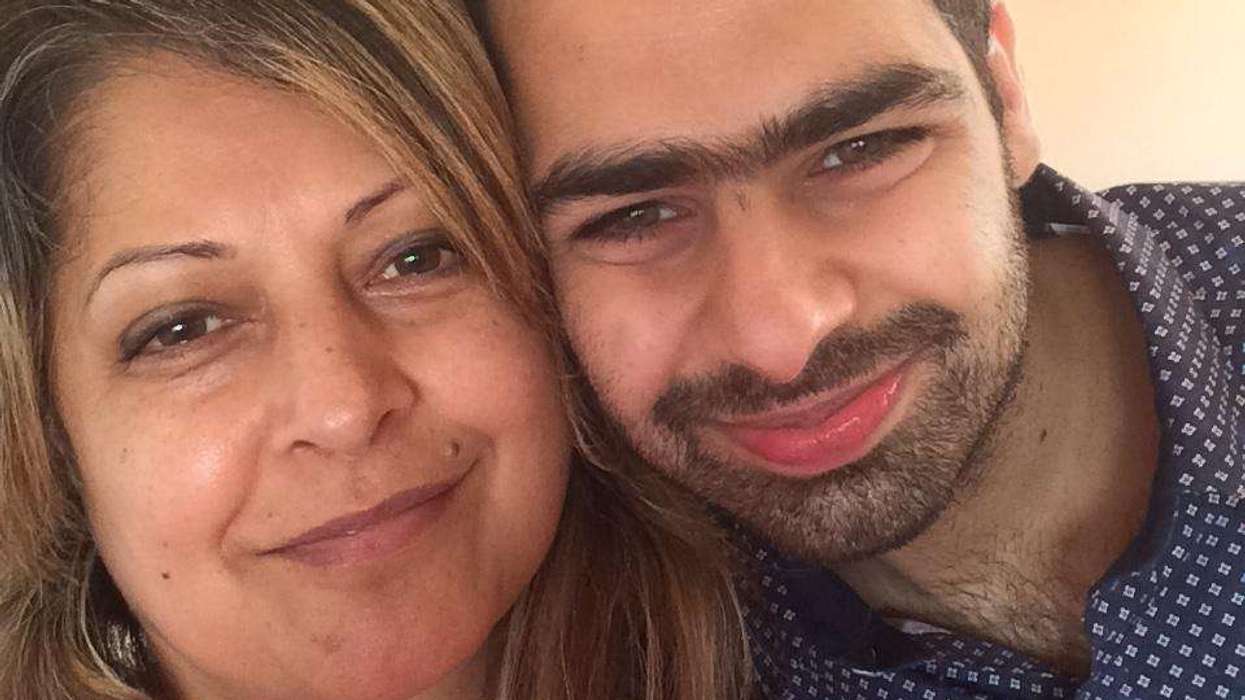 Bevi Sandhu with her son, Sunni BansalNHSBT
 Harpreet MatharuNHS