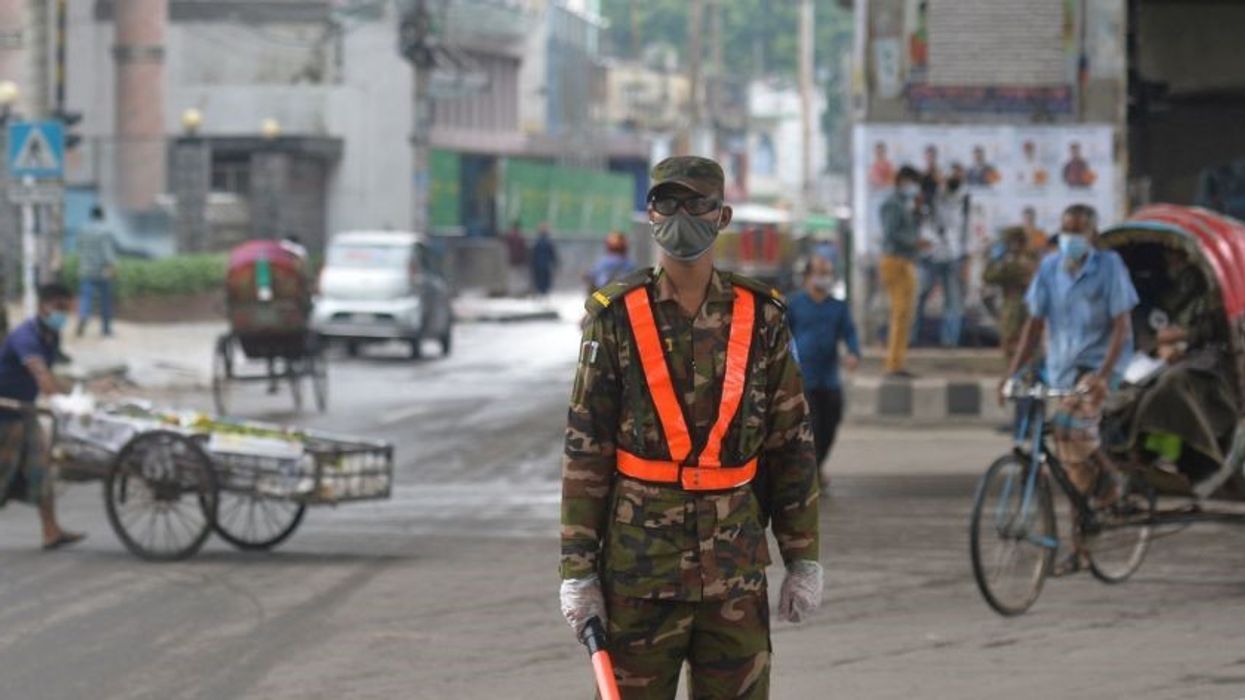

BANGLADESH’S army and police patrolled empty streets on Thursday (1) as a strict week-long Covid-19 lockdown began, with people confined to their homes except for emergencies and purchase of essentials.
The government said the country of 168 million people is seeing an "alarming and dangerous" rise of new infections, blamed largely on the highly infectious delta variant.
Hospitals are struggling, particularly in areas bordering India where the strain was first detected in the country. Some rural towns have recorded infection rates of 70 per cent.
On the first day of the week-long shutdown, Dhaka's normally bustling streets were deserted as soldiers in military fatigues carried out patrols and set up checkpoints.
Dhaka's police chief said anyone leaving home “without a good reason” would be fined and may face arrest.
"If we need to file 5,000 cases and arrests a day, we will," Shafiqul Islam said.
The shutdown announcement last week sparked an exodus of migrant workers from Dhaka, with thousands cramming onto dangerously packed ferries in the delta nation.
"We are hopeful these tough measures will work. We have to contain the virus at any cost," health department spokesman Robed Amin said.
But Sagar, an 18-year-old street food seller in Dhaka, was angry.
"The government is imposing the lockdown only to kill the poor. There will be no work for us, no help from anyone," he said.
All offices and shops were shut with only local food markets allowed to open for a few hours a day.
However, garment factories that form a key pillar of the Bangladeshi economy are allowed to open. Stock markets and commercial banks can also operate for a few hours a day.
Touhidul Islam Chowdhury, who owns a small loan recovery firm, said the shutdown should be enforced strictly.
"A lot of people are dying and getting infected," he said. "The army should have deployed much earlier."
Bangladesh has reported nearly 900,000 infections and more than 14,500 virus deaths.
More than two-thirds of new cases in Dhaka are of the delta variant, according to a recent study by the Dhaka-based International Centre for Diarrhoeal Disease Research.
Unlike the previous two waves, the rural heartland where more than 60 per cent of the population live has been hit, with reports saying local graveyards are overwhelmed.
In Satkhira district in the southwest, authorities are probing media reports that seven coronavirus patients died after a hospital ran out of oxygen, local official Humayun Kabir said.
Television footage showed hundreds of people crowding a top hospital in Dhaka for Covid-19 vaccines.
The first phase of the vaccination drive ground to a halt after India stopped exporting AstraZeneca vaccines earlier this year to focus on its own needs.
Bangladesh is expected to receive this weekend the first shipment of 2.5 million Moderna vaccines promised by the United States.
A Chinese embassy official said Beijing is also sending about two million Sinopharm vaccine doses that Dhaka bought, adding to the 1.1 million shots already donated by China.