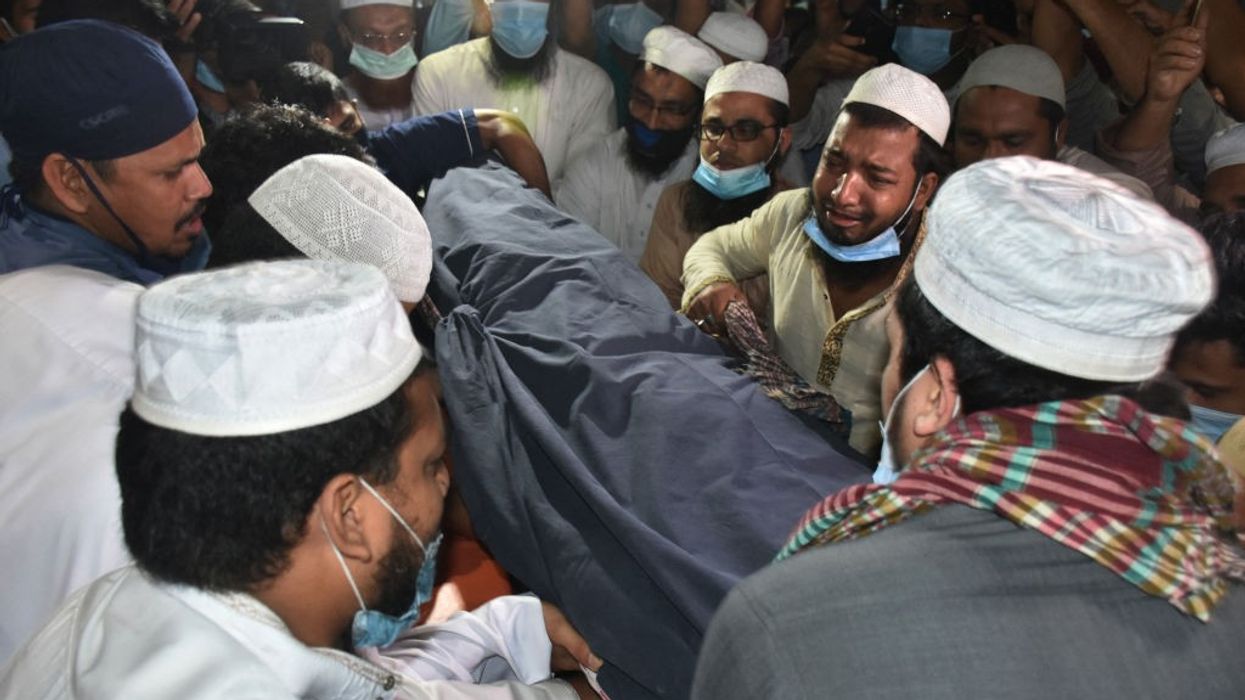

TENS of thousands of people attended the funeral of the firebrand leader of Bangladesh's hardline Islamist outfit just hours after he died in the port city of Chittagong, police said.
Junaid Babunagari - who in November took over as the chief of the fundamentalist Hefazat-e-Islam, the largest Islamist group in Bangladesh - died after a kidney complication.
"Between 70,000 and 80,000 people attended his funeral prayers," held late Thursday (19) on the grounds of the madrassa where he taught, Chittagong's deputy chief of police, Afruzul Haque Tutul, said.
Hefazat's general secretary Nurul Islam Jehadi put the attendance at the funeral prayers held in Hathazari, a town on the northern outskirts of Chittagong, at several hundred thousand.
Babunagari, who was believed to be about 70, died after being rushed to a hospital in Chittagong, the country's second-largest city, Hefazat spokesman Meer Idris said.
As the news of his death spread, thousands of Hefazat supporters gathered outside the hospital.
Bangladesh home minister Asaduzzaman Khan offered his condolences.
Hefazat, which was founded in 2010, draws its support from millions of students and teachers in thousands of madrassas across Bangladesh, a Muslim majority country of 169 million people.
Babunagari rose from obscurity into the spotlight in 2012 when he became the deputy chief of Hefazat. He was known as being a hardliner within the fundamentalist group.
A 2013 rally in Dhaka by thousands of Hefazat supporters demanding a blasphemy law ended in unrest and dozens of deaths.
In recent months, hundreds of Hefazat leaders and activists were arrested in a nationwide crackdown, which followed the group's deadly protests over Indian Prime Minister Narendra Modi's visit to Bangladesh. More than a dozen Hefazat activists were shot dead in the incidents.






 Curator Emma Slocombe with ikat robes and arabachi coats in the Peter the Great Room in Blickling Hall Amit Roy
 View of the entrance to Blickling Hall on a rainy autumn dayAmit Roy
 Kente cloth from Ghana in the Long Gallery in Blickling Hall
 Decoration in the Great Hall at Blickling Hall Amit Roy
 Palampore fragment made in coastal south-east India in the Brown Room in Blickling Hall Amit Roy
 Bed valance dating from early 1700s in the Italian Print Room at Blickling Hall Amit Roy
 Indian inspired fabric draped on sofas in the South Drawing Room in Blickling Hall Amit Roy
 Indian inspired fabric draped on sofas in the South Drawing Room with Indian carpet in Blickling Hall Amit Roy
 Karun Thakar has picked out the geometric patterns in the bookcase and the Kente cloth in the Long Gallery in Blickling Hall Amit Roy
 Large tapestry depicting Peter the Great defeating the Swedish army at the Battle of Poltava in 1709 Amit Roy
 ikat robes and arabachi coats in the Peter the Great Room in Blickling Hall Amit Roy
 Baghs and kanthas made by women provide contrast to the men only portraits in the Great Hall at Blickling Hall Amit Roy
 Baghs and kanthas in the entrance Great Hall at Blickling Hall Amit Roy
 Baghs and Kanthas in the Great Hall in harmony with stained glass window at Blickling Hall Amit Roy
 Kimonos reflect Japanese influence in Upper Ante Room in Blickling Hall Amit Roy
 Kimono in Upper Ante Room in Blickling Hall
 A view of the Palace and fort at Agra shows romantic side of India Amit Roy
 Blickling Hall Amit Roy
 Table carpet, European 1670-1680 Amit Roy
 Unfinished 17th century Italian embroidery in the Print Room at Blickling Hall Amit Roy
 Picture of Kashmir shows a romantic view of India Amit Roy
 A panel of Ashburnham bed hangings made in Gujarat for sale in Europe in the Brown Room in Blickling Hall Amit Roy
 Colcha made in the 1600s by women in Bengal for the Portuguese market in the Long Gallery at Blickling Hall Amit Roy




