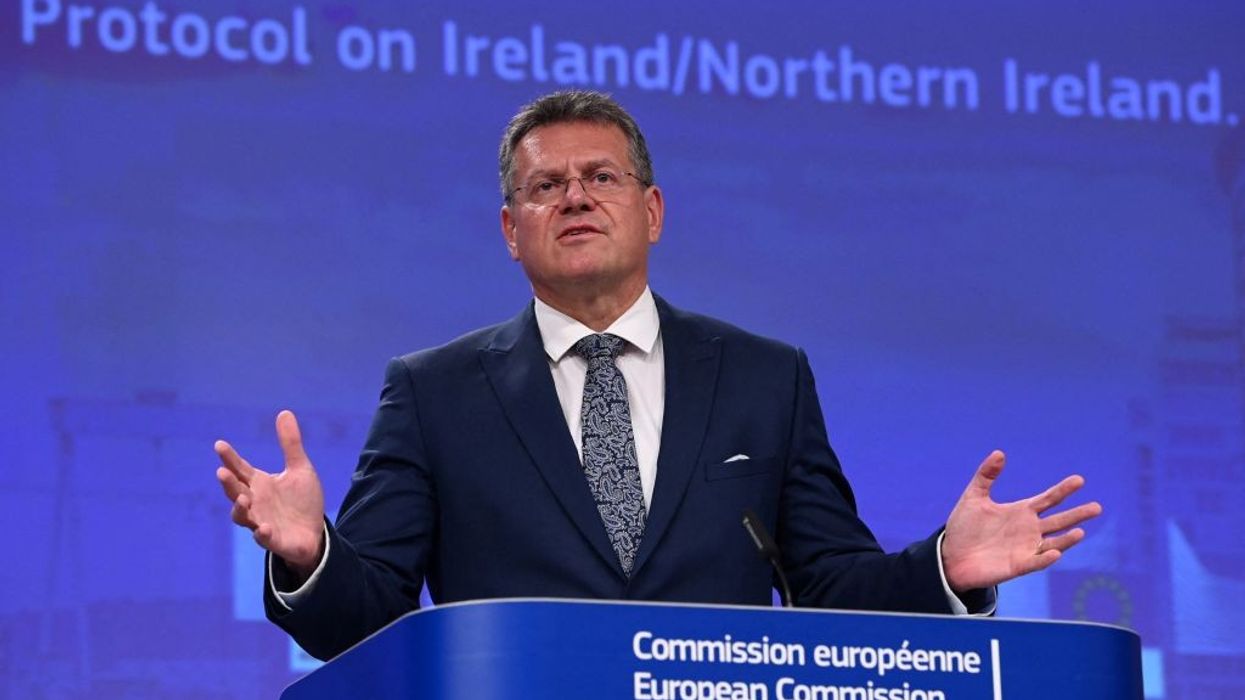

The European Commission launched new legal action against Britain on Wednesday, accusing London of putting peace in Northern Ireland at risk by trying to overhaul the post-Brexit trade deal.
"The UK government tabled legislation confirming its intention to unilaterally break international law," EU commission vice-president Maros Sefcovic said.
"More precisely to break an agreement that protects peace and stability in Northern Ireland," he said.
"Opening the door to unilaterally changing an international agreement is a breach of international law, as well. So let's call a spade a spade. This is illegal."
On Monday, the British government introduced legislation to rip up post-Brexit trading rules for Northern Ireland, in an attempt to override the EU withdrawal treaty that it had signed.
Prime Minister Boris Johnson's government insists it is not breaking international law, citing a "necessity" to act to restore Northern Ireland's power-sharing institutions.
But Brussels rejects this argument, and Sefcovic said that legal action would be taken, with two new cases joining those the commission had suspended.
Sefcovic said the EU would revive a case is launched last year to control the export of certain food products from Great Britain to Northern Ireland.
"If the UK doesn't reply within two months, we may take them to the Court of Justice," he warned.
"Second, we are launching two new infringements against the UK," he said, announcing cases that could see the British government brought before the European Court of Justice.
"One for failing to carry out the necessary controls at the border control posts in Northern Ireland by ensuring adequate staffing and infrastructure.
"And one for failing to provide the EU with essential trade statistics data to enable the EU to protect its single market."
'Grave peril'
The cases brought by the EU do not directly tackle the proposed UK legislation, but rather seek to compel Britain to implement the existing agreements.
Johnson's government has said it would still prefer a negotiated outcome with the European Union to reform the Northern Ireland Protocol.
But it accuses Brussels of failing to engage on its concerns about measures to control goods moving from Great Britain to Northern Ireland.
Brussels counters that, with Northern Ireland remaining in the EU single market, European law must ultimately apply to goods arriving in the territory.
And Sefcovic says that attempts to negotiate a compromise with Britain within the terms of the agreement Johnson himself hailed and signed have been met with "radio silence" since February.
The spat comes at a bad time for the UK economy, with inflation at 40-year highs and rising household bills that have left many Britons struggling to make ends meet.
But there are economic headwinds in the European Union too, and warnings that the West must not fall out over trade when trying to present a united front against Russia's invasion of Ukraine.
Irish Minister for Foreign Affairs Simon Coveney said Wednesday's EU action is "the result of a deliberate UK Government strategy of provocation over partnership".
"Reckless UK decisions this week have forced the EU into responding to a threatened breach of international law with serious consequences."
Jonathan Jones, the former head of the UK government legal service scoffed at Number 10's argument.
Jones resigned after Northern Ireland minister Brandon Lewis admitted that unilaterally breaking the deal would "break international law in a very specific and limited way".
"The concept of 'necessity' is an extremely high test. It applies only where a state must act to safeguard its essential interests against 'grave and imminent peril'," Jones said.
"How can an agreement willingly entered into only in 2020, at what the Prime Minister described as a 'fantastic moment', be already proving so disastrous as to represent 'grave peril' to the country?"
Meanwhile, the Democratic Unionist Party argues the protocol's creation of an effective border in the Irish Sea jeopardises Northern Ireland's status in the wider UK.
The pro-British party is boycotting the local government in Belfast until the deal is scrapped or dramatically overhauled, putting at risk the power-sharing agreement that underlies the Northern Ireland peace agreement.
(AFP)