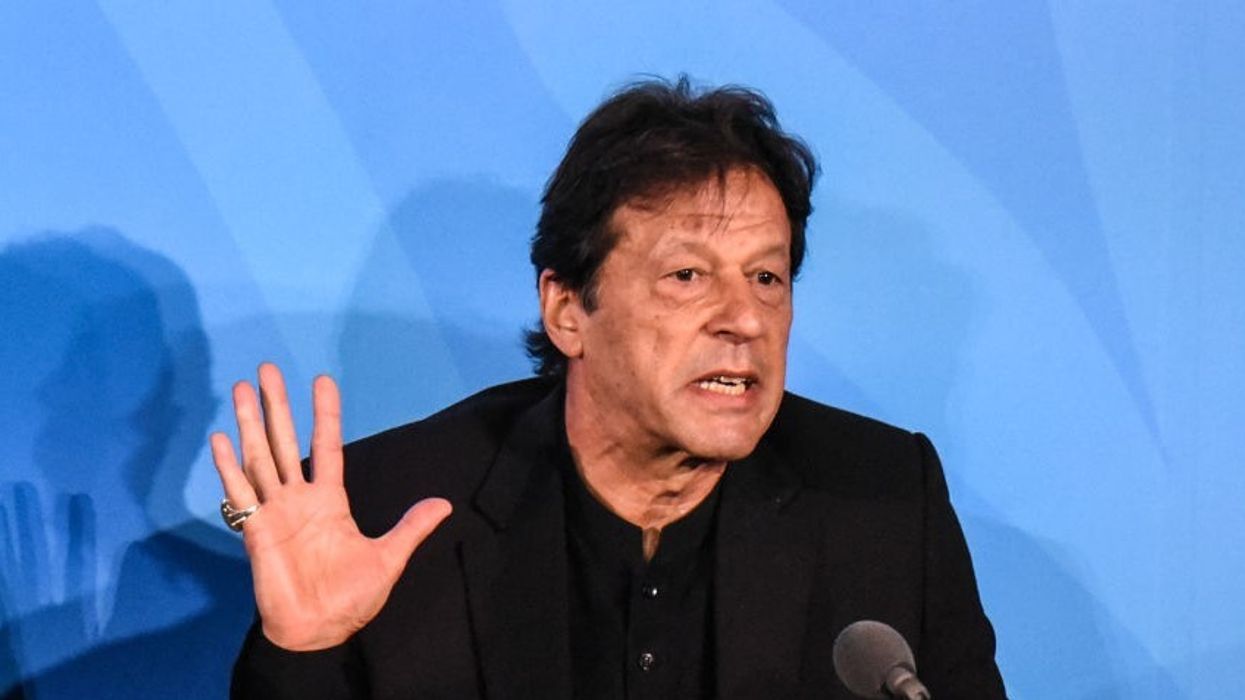

PAKISTAN prime minister Imran Khan has ruled out hosting American bases in his country for military action inside war-torn Afghanistan, fearing it might lead to Pakistan being "targeted in revenge attacks" by terrorists.
In an opinion piece in The Washington Post ahead of US president Joe Biden's meeting with top Afghan leaders at the White House later this week, Khan also questioned the efficacy of US bases in Pakistan.
"We simply cannot afford this. We have already paid too heavy a price,” Khan said, amid reports that the US continues to focus on Pakistan for a military base in the region.
He added, “If Pakistan were to agree to host US bases, from which to bomb Afghanistan, and an Afghan civil war ensued, Pakistan would be targeted for revenge by terrorists again.
“If the United States, with the most powerful military machine in history, couldn't win the war from inside Afghanistan after 20 years, how would America do it from bases in our country?”
Khan, however, stressed that Pakistan and the US have the same interests in Afghanistan - a political settlement, stability, economic development and the denial of any haven for terrorists.
"We want a negotiated peace, not civil war," he wrote.
Khan said Pakistan is ready to be a partner for peace in Afghanistan with the US, but “we will avoid risking further conflict” after the withdrawal of American troops.
Biden's talks with Afghan president Ashraf Ghani and Afghanistan's High Council for National Reconciliation chairman, Abdullah Abdullah, on Friday (25) will centre on US troop withdrawal amid a surge in fighting between Afghan forces and the Taliban.
Khan said Pakistan in the past had made a mistake by choosing between warring Afghan parties but said the country had learned from the experience.
“We have no favourites and will work with any government that enjoys the confidence of the Afghan people. History proves that Afghanistan can never be controlled from outside,” he said.
Khan noted that the wars in Afghanistan left more than 70,000 Pakistanis dead. While the United States provided $20 billion (£14.3 bn) in aid, losses to the Pakistani economy exceeded $150bn (£107.9bn).
He said tourism and investment dried up and after joining the US effort, Pakistan was targeted as a collaborator, “leading to terrorism against our country from the Tehreek-e-Taliban Pakistan and other groups”.
He also questioned the use of US drone attacks, which “I warned against”, and said they didn't win the war, but that they created hatred for Americans, “swelling the ranks of terrorist groups against both our countries”.
More than three million Afghan refugees are in Pakistan and their number may increase in case of further civil war in Afghanistan, he cautioned.
Khan said most of the Taliban are from the Pashtun ethnic group and more than half the Pashtuns live on the Pakistan side of the border.
“This is why we have done a lot of real diplomatic heavy lifting to bring the Taliban to the negotiating table, first with the Americans, and then with the Afghan government.”
"We know that if the Taliban tries to declare a military victory, it will lead to endless bloodshed. We hope the Afghan government will also show more flexibility in the talks, and stop blaming Pakistan, as we are doing everything we can short of military action,” he said.