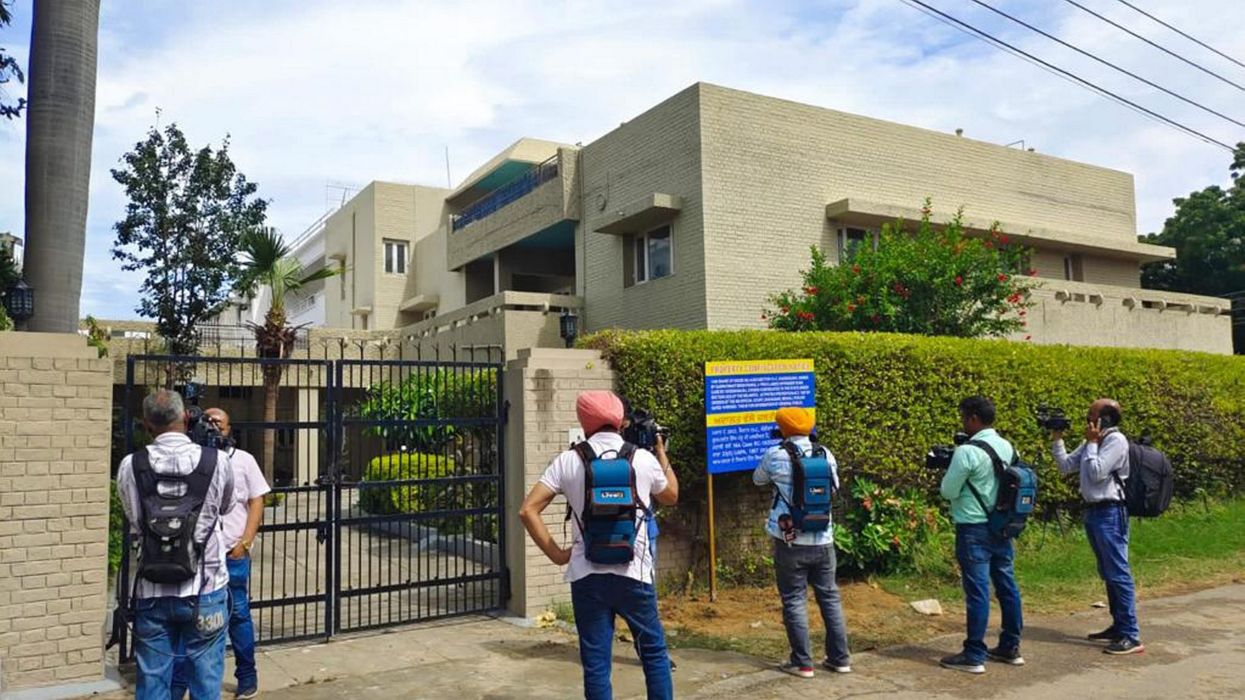
INDIA'S top investigation agency has confiscated the properties of a prominent Sikh separatist and close ally of Hardeep Singh Nijjar, whose killing has sparked a diplomatic row between India and Canada.
Gurpatwant Singh Pannun, a lawyer believed to be based in Canada, was designated as a terrorist by Indian authorities in 2020 and is wanted on charges of terrorism and sedition.
He is also the founder of the US-based group Sikhs For Justice (SFJ), whose Canada chapter was headed by Nijjar before he was gunned down by masked assailants in June near Vancouver.
The group, which has been banned by India, has been a vocal advocate for the creation of an independent Sikh homeland called Khalistan.
A diplomatic firestorm erupted last week with Canadian prime minister Justin Trudeau saying there were "credible reasons to believe that agents of the government of India were involved" in Nijjar's death.
New Delhi dismissed Trudeau's allegations as "absurd", tit-for-tat diplomatic expulsions followed, and India has stopped processing visa applications by Canadians.
Pannun jumped into the raging row and issued a video telling Canadian Hindus to "go back to India", claiming they had adopted a "jingoistic approach" by siding with New Delhi.
In an interview with an Indian news channel, Pannun said Nijjar had been his "close associate" for more than 20 years and was like a "younger brother" to him. He also blamed India for Nijjar's killing.
'Heinous crimes'
Soon after his interview was aired, the Indian government issued an advisory to news networks asking them to refrain from giving a platform to people accused of "heinous crimes".
Armed with court orders, officials of India's National Investigation Agency (NIA) on Saturday (23) confiscated Pannun's house in Chandigarh, the capital of the Sikh-majority state of Punjab, it said in a statement.
The NIA also confiscated agricultural land belonging to him in Amritsar, it added.
It accused Pannun of "actively exhorting Punjab-based gangsters and youth" on social media "to fight for the cause of independent state of Khalistan, challenging the sovereignty, integrity and security of the country".
In a statement mailed to AFP, Pannun's office downplayed the confiscation of his properties.
"The issue at the heart of the conflict with India is not the properties of Pannun," it said.
"This is about the Sikh homeland Punjab that is occupied by India and the resources of the indigenous people of Punjab that are being plundered by Delhi," it added.
Sikhism is a minority religion originating in northern India that traces its roots back to the 15th century and drew influences from both Hinduism and Islam.
The Khalistan campaign was largely considered a benign fringe movement until the early 1980s, when a Sikh fundamentalist launched a violent separatist insurgency.
It culminated with Indian forces storming the Golden Temple, the faith's holiest shrine in Amritsar, where separatists had barricaded themselves.
India's prime minister Indira Gandhi was subsequently assassinated by two of her Sikh bodyguards.
The insurgency was eventually brought under control and the Khalistan movement's most vocal advocates are now among the large Sikh diaspora, particularly in Canada, Britain and Australia.
But memories of the violence - in which thousands died - still haunt India, which has outlawed the Khalistan movement and listed several associated groups as "terrorist organisations".
(AFP)
India confiscates properties of Nijjar’s ally
Sikhs For Justice founder Pannun's office downplays New Delhi's action