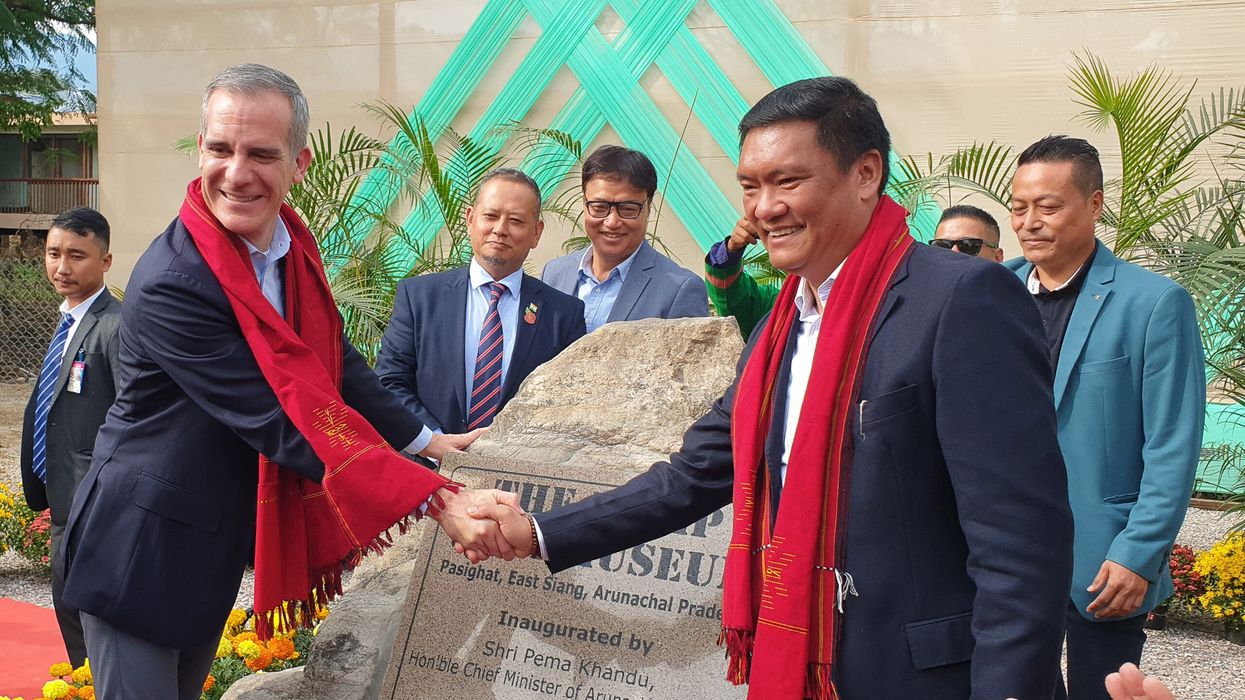

INDIA paid tribute Wednesday (29) to the hundreds of US servicemen killed during World War II with the opening of a museum near its strategic border with China honouring the dramatic Himalayan airlift dubbed "The Hump".
Telling the story of how Allied pilots flew the perilous route to supply Chinese forces, it includes 80-year-old rusting wreckage and machine guns of some of the 590 planes that crashed into the jungle hills and jagged mountains of India's northeast Arunachal Pradesh state.
Arunachal Pradesh chief minister Pema Khandu said it showcased "the remnants of aircrafts that went missing", as he inaugurated "The Hump WWII Museum" alongside US ambassador Eric Garcetti in the town of Pasighat.
Khandu said American families had "sent their relics and artefacts for this museum in memory of their great-grandfathers who lost their lives while flying over the tough mountains of Arunachal Pradesh during the Second World War".
Pilots nicknamed the dangerous route over the ice-covered eastern Himalayan mountains "The Hump", a giant airlift to supply Chinese troops battling Japanese forces after they cut off the overland route through Burma, today's Myanmar.
It also earned the moniker the "Aluminium Trail" because of the number of crashes.
The remains of aircraft are still found smothered in Arunachal Pradesh's rugged jungle hills, sandwiched between Myanmar and China.
Today, Washington and Beijing are rival superpowers, while China claims almost all of India's Arunachal Pradesh is part of its territory as "South Tibet".
New Delhi, who is wary of Beijing's growing military assertiveness along their 3,500-kilometre (2,175-mile) shared frontier, consistently maintains that the state is an "integral and inalienable part of India".
According to the China-Burma-India Hump Pilots Association, 590 planes went down with the loss of more than 1,650 lives from April 1942 until near the end of the war in 1945.
The National Museum of the US Air Force called it the "greatest sustained aerial transport achievement of the war".
They ferried around 650,000 tonnes of fuel, munitions and equipment through some of the toughest of flying conditions over the mountains.
The "obstacles posed by terrain and the extremes in climate were difficulties never before experienced in mass operation of aircraft", the Ohio-based US Air Force museum added, calling it the "world's first strategic airlift".
The US Defense POW/MIA Accounting Agency (DPAA), the US agency that deals with soldiers missing in action, has sent repeated teams to Arunachal Pradesh to locate the remains of missing servicemen.
"Several struggles were made scaling high and tough mountains across Arunachal Pradesh to recover the fallen aircraft of the US and finally we have come up with this beautiful museum in memory of those fallen airmen", the museum's director Oken Tayeng said.
(AFP)