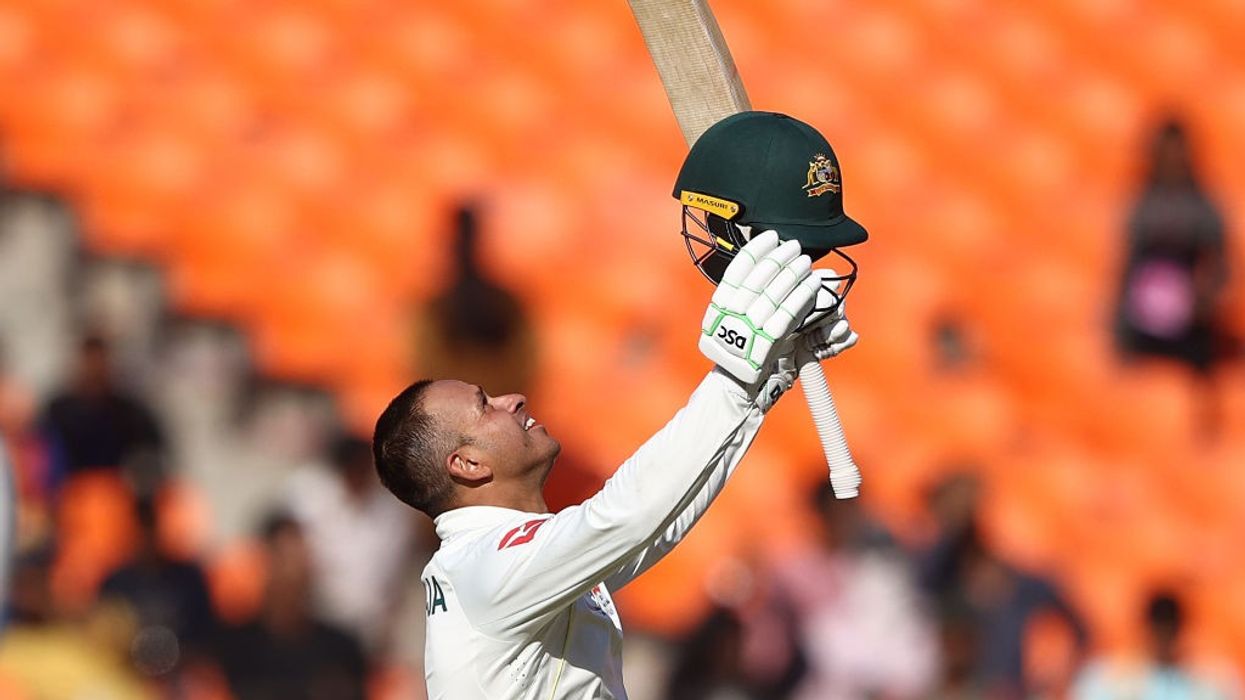

USMAN KHAWAJA smashed the first century by an Australia batter in the current series against India to steer the tourists to 255 for four after the opening day of the fourth and final test on Thursday (9).
The opener forged 50-plus partnerships with Travis Head, Steve Smith and Cameron Green in easily the best batting conditions so far to put Australia on course for their highest total in the series.
Khawaja brought up his 14th test hundred in the final over of the day and remained unbeaten on 104, which included 15 boundaries.
Cameron Green was batting on 49 at the other end after putting on 85 runs with Khawaja.
Australia scored at a run-a-ball rate in the last nine overs of the day, after India had taken the second new ball, at the Narendra Modi Stadium.
"It was such a nice wicket. I just didn't want to give my wicket away," Khawaja said.
"That was a mental battle more than anything else because you have to put your ego away."
It has been a bowler-dominated series so far with each of the first three tests ending inside three days and spinners from both sides ruled the roost.
The pitch in Ahmedabad finally brought some relief to the batters and the 61-run opening stand between Khawaja and Head vindicated Smith's decision to bat first.
Head could have been dismissed for seven but KS Bharat dropped a waist-high sitter after the opener had edged Umesh Yadav.
Head, who made 32, kept playing his shots but did not get his timing right against Ravichandran Ashwin and was caught at mid-on by Ravindra Jadeja.
India tasted further success largely because of Marnus Labuschagne's penchant to occasionally get stuck in the crease.
The right-hander, currently the top-ranked test batsman, made three before dragging a Mohammed Shami delivery onto his stumps.
Khawaja was joined in the middle by Smith, leading Australia in the absence of regular skipper Pat Cummins, who flew home to be with his ailing mother.
The series saw its first wicketless session when Khawaja and Smith combined to deny India a breakthrough in the second segment of the day.
Jadeja ended that 79-run partnership soon after the tea break when Smith, having made 38, presented an angled bat only to deflect the ball onto his stumps.
Shami sent Peter Handscomb's (17) off-stump cartwheeling but Green and Khawaja scored freely.
"Unlike the previous pitches, it's definitely a good batting track," India's bowling coach Paras Mhambrey told reporters.
"They batted well in the first session. We did well in the second session but again they scored freely after we took the new ball.
"I think that's where the game drifted slightly away from us. Restricting them to 220-225 would have been nice."
India, who lead the series 2-1, need to win the match to join Australia in the final of the World Test Championship at The Oval in June.
(Reuters)