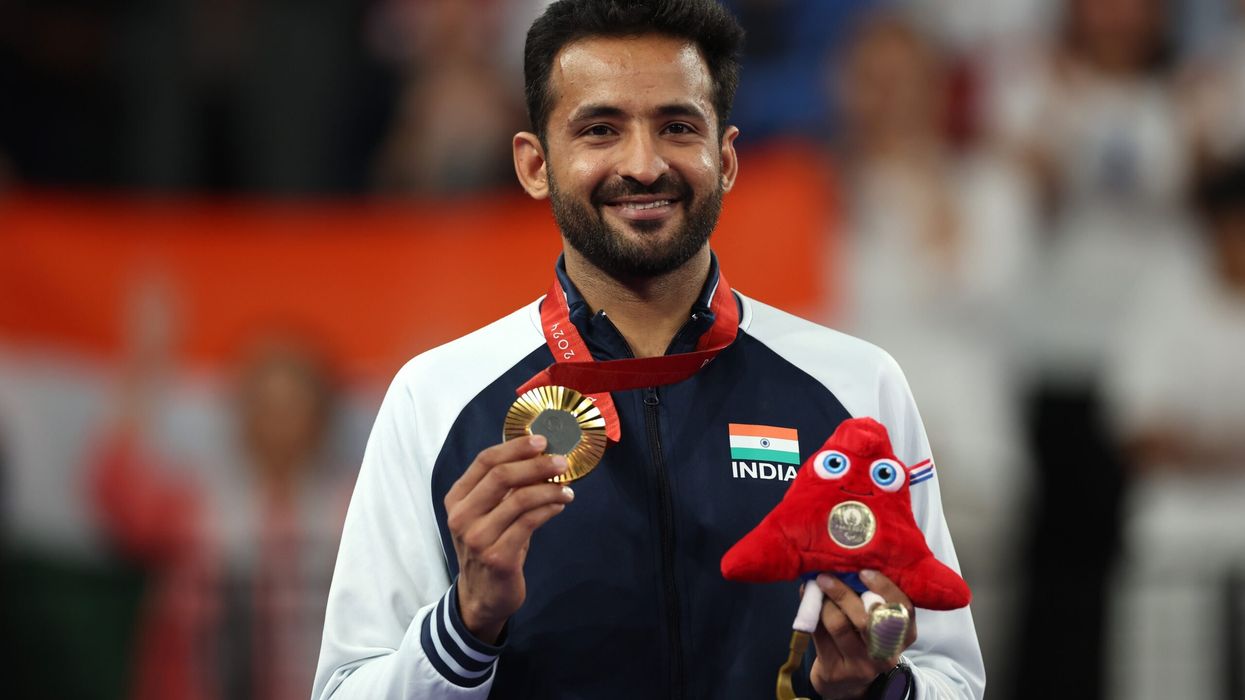

INDIA's Kumar Nitesh secured his first gold medal at the Paralympics, defeating Great Britain's Daniel Bethell in the men's singles SL3 badminton final on Monday.
The 29-year-old from Haryana won the match after a challenging contest that lasted an hour and 20 minutes, with the final scoreline at 21-14, 18-21, 23-21.
"I still don't feel it. Maybe when I go to the podium and the national anthem is played, it will sink in," Nitesh said following the match.
Nitesh, who competes in the SL3 category for players with severe lower limb disabilities, lost his left leg in a train accident in 2009. Despite this, he persevered and achieved a significant personal victory.
His win also ensured that India retained the SL3 gold, following Pramod Bhagat's victory three years ago when badminton was introduced to the Paralympics in Tokyo.
Facing an opponent who had beaten him nine times before, Nitesh, an IIT Mandi graduate, managed to secure his first win over Bethell. "I didn't think it this way. Thoughts were coming into my mind about how I will win. But I was not thinking about what I will do after I win; I pushed that feeling away," he said.
The final match was intense, with both players engaging in long rallies, including a nearly three-minute rally of 122 shots in the first game. Nitesh's strategy included sharp reverse hits, delicate drop shots, and precise net play that kept Bethell on the defensive throughout.
In the first game, Nitesh was trailing 6-9 at one point but managed to recover and take a two-point lead into the break. He then advanced to an 18-14 lead and won the game when Bethell sent the shuttle wide. Although Nitesh had the chance to win in straight games, Bethell fought back, forcing the match into a third game.
In the deciding game, both players remained evenly matched, moving from 8-8 to 19-19. Nitesh had his first championship point at 20-19 but couldn't convert it. Bethell also had a match point at 21-20 but missed at the net. Finally, Nitesh capitalized on Bethell's mistakes to win the match.
"I have lost such situations against him before, and I didn't want to make the same mistakes. At 19-20 in the decider, I told myself to stick in there and make him earn the point," Nitesh said.
Earlier in the day, there was disappointment for second seeds Sivarajan Solaimalai and Nithua Sre Sumathy Sivan, who lost 17-21, 12-21 to Indonesia's Subhan and Rina Marlina in the mixed doubles SH6 bronze medal play-off.
(With inputs from PTI)