ALL four Indian nationals accused of murdering Khalistani separatist leader Hardeep Singh Nijjar have been granted bail by a court in Canada.
The accused, identified as Karan Brar, Amandeep Singh, Kamalpreet Singh, and Karanpreet Singh, face charges of first-degree murder and conspiracy to commit murder.
The case, which has drawn international attention, will now proceed at the British Columbia Supreme Court, with the next hearing scheduled for 11 February 2025, as reported by India Today.
Nijjar, a prominent pro-Khalistan leader, was killed in Surrey, British Columbia, in June 2023. His assassination became the focus of a diplomatic row after Canadian prime minister Justin Trudeau accused the Indian government of involvement. India has strongly denied these allegations, labelling them as "baseless."
The Royal Canadian Mounted Police (RCMP) arrested the four accused in May 2024 from different locations across Canada. However, delays in evidence presentation by the prosecution during preliminary hearings led to their release under a "stay of proceedings" while awaiting trial. Court records indicate that all four are "not" in custody, meaning they are either out on bail or released under specific conditions.
The Canadian government has employed a "direct indictment," expediting the case to trial by transferring it from Surrey Provincial Court to British Columbia Supreme Court.
A publication ban, requested by the Crown and agreed upon by defence counsel, restricts updates on pre-trial proceedings.
A Prosecution Service official confirmed that pre-trial motions will take place before the trial, but no timeline has been provided.

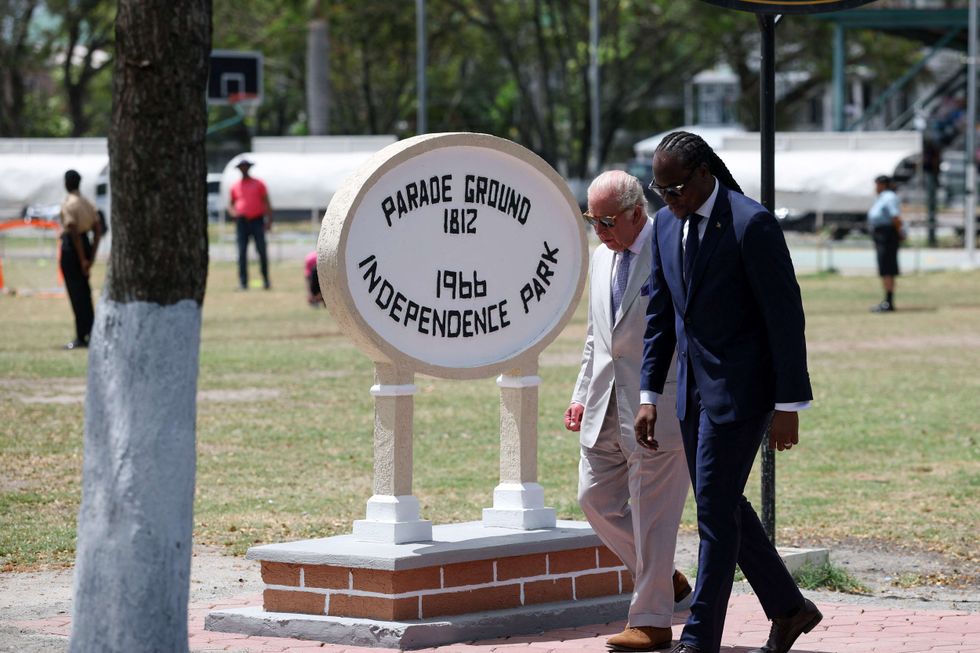 King Charles III, accompanied by Steven Jacobs, a Minister within Guyana's Ministry of Culture, Youth and Sport, visits Independence Park, which marks the site of public executions following the 1823 Demerara Slave Rebellion, during his tour of Caribbean nations on October 30, 2026 in Georgetown, Guyana. Getty Images