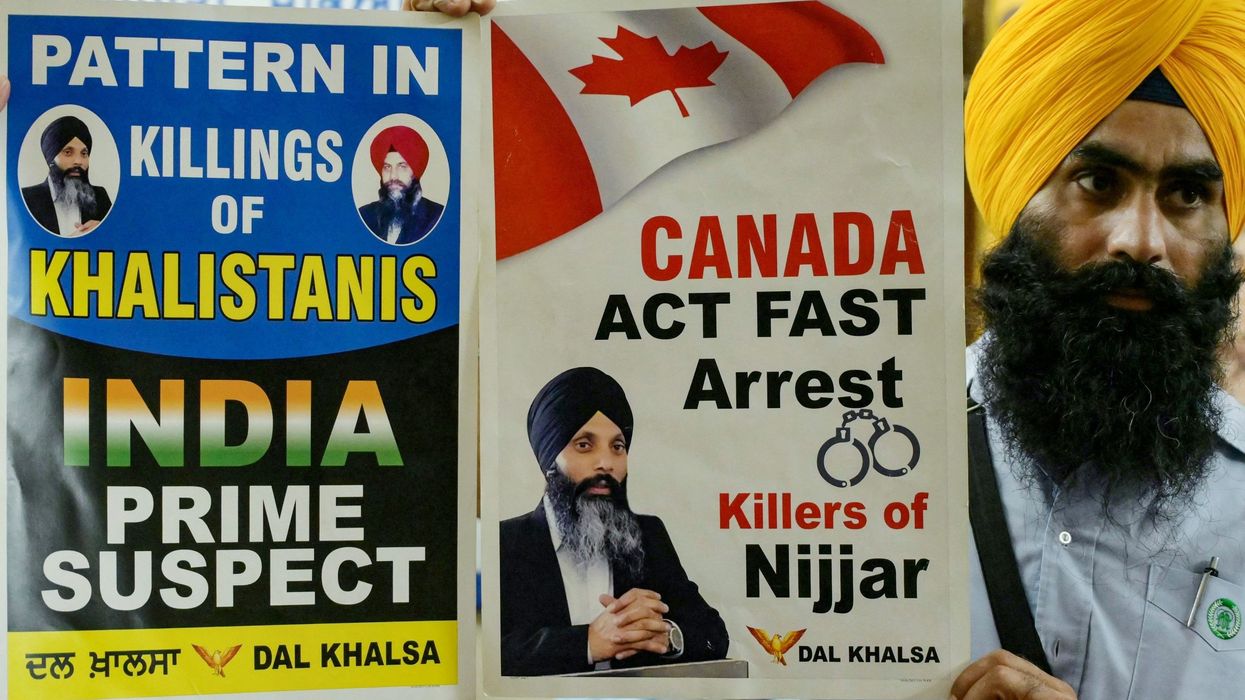

After the killing of Sikh separatist Hardeep Singh Nijjar, intelligence was shared by the US with Canada, The New York Times has reported. However, according to NYT, Ottawa's interception of communications provided more conclusive evidence, leading Canada to accuse India of masterminding the plot.
The report came on Saturday (23) as the top US diplomat in Canada confirmed that there was “shared intelligence among Five Eyes partners” that had prompted Canadian prime minister Justin Trudeau's offensive allegation against India in the killing of a Khalistani extremist on Canadian soil.
The allegations have infuriated India, which rejected the allegations as "absurd" and "motivated" and expelled a senior Canadian diplomat in a tit-for-tat move to Ottawa's expulsion of an Indian official over the case.
India also accused Canada of being a safe haven for terrorists.
Nijjar, the chief of the banned Khalistan Tiger Force (KTF), was killed in Surrey in British Columbia on June 18. India had designated Nijjar as a terrorist in 2020. The US has urged India to cooperate with Canada in its investigations.
"In the aftermath of the killing, US intelligence agencies offered their Canadian counterparts context that helped Canada conclude that India had been involved," the NYT reported, quoting unnamed allied officials as saying.
Yet what appears to be the “smoking gun,” intercepted communications of Indian diplomats in Canada indicating involvement in the plot, was gathered by Canadian officials, allied officials said.
David Cohen, US Ambassador to Canada, in an interview with CTV News said that "shared intelligence among Five Eyes partners" had informed Trudeau of the possible involvement of Indian agents in the murder of a Canadian citizen in June.
"I will say this was a matter of shared intelligence information. There was a lot of communication between Canada and the United States about this, and I think that's as far as I'm comfortable going," Cohen told CTV News.
After Nijjar's death, American officials told their Canadian counterparts that Washington had not had any advance information about the plot, and that if US officials had they would have immediately informed Ottawa under the intelligence agencies' “duty to warn” doctrine, according to two allied officials, the newspaper reported.
The officials, who spoke on the condition of anonymity to discuss what has become a diplomatic firestorm, said Canadian officials had offered a general warning to Nijjar but had not told him that he was the target of an Indian government plot, according to the report.
Cohen told CTV that said that the US takes very seriously these allegations. “And, you know, if they prove to be true, it is a potentially very serious breach of the rules-based international order in which we like to function," he said in response to a question.
While Secretary of State Antony Blinken has called on India to cooperate with the Canadian investigation, American officials have largely tried to avoid triggering any diplomatic blowback from India, the paper said.
But the disclosure of the involvement of US intelligence risks ensnaring Washington in the diplomatic battle between Canada and India at a time when it is keen to develop New Delhi as a closer partner, it said.
Blinken said the US is “deeply concerned” about the allegations raised by Trudeau against India and Washington was “closely coordinating” with Ottawa on the issue and wants to see “accountability” in the case.
Speaking at a press conference in New York on Friday, Blinken said the US has engaged directly with the Indian government on the issue and the most productive thing would be the completion of this investigation.
Trudeau on Friday said that Canada shared with India "many weeks ago" evidence on the killing of Nijjar and wants New Delhi to commit constructively with Ottawa to establish the facts in the "very serious matter."
When asked about Canada sharing any information in the case with India, the Ministry of External Affairs (MEA) in New Delhi said, "No specific information has been shared by Canada on this case, either then or before or after. We have, you know, as we have said, or I think we have made very clear, we are willing to look at any specific information."
(PTI)






 Curator Emma Slocombe with ikat robes and arabachi coats in the Peter the Great Room in Blickling Hall Amit Roy
 View of the entrance to Blickling Hall on a rainy autumn dayAmit Roy
 Kente cloth from Ghana in the Long Gallery in Blickling Hall
 Decoration in the Great Hall at Blickling Hall Amit Roy
 Palampore fragment made in coastal south-east India in the Brown Room in Blickling Hall Amit Roy
 Bed valance dating from early 1700s in the Italian Print Room at Blickling Hall Amit Roy
 Indian inspired fabric draped on sofas in the South Drawing Room in Blickling Hall Amit Roy
 Indian inspired fabric draped on sofas in the South Drawing Room with Indian carpet in Blickling Hall Amit Roy
 Karun Thakar has picked out the geometric patterns in the bookcase and the Kente cloth in the Long Gallery in Blickling Hall Amit Roy
 Large tapestry depicting Peter the Great defeating the Swedish army at the Battle of Poltava in 1709 Amit Roy
 ikat robes and arabachi coats in the Peter the Great Room in Blickling Hall Amit Roy
 Baghs and kanthas made by women provide contrast to the men only portraits in the Great Hall at Blickling Hall Amit Roy
 Baghs and kanthas in the entrance Great Hall at Blickling Hall Amit Roy
 Baghs and Kanthas in the Great Hall in harmony with stained glass window at Blickling Hall Amit Roy
 Kimonos reflect Japanese influence in Upper Ante Room in Blickling Hall Amit Roy
 Kimono in Upper Ante Room in Blickling Hall
 A view of the Palace and fort at Agra shows romantic side of India Amit Roy
 Blickling Hall Amit Roy
 Table carpet, European 1670-1680 Amit Roy
 Unfinished 17th century Italian embroidery in the Print Room at Blickling Hall Amit Roy
 Picture of Kashmir shows a romantic view of India Amit Roy
 A panel of Ashburnham bed hangings made in Gujarat for sale in Europe in the Brown Room in Blickling Hall Amit Roy
 Colcha made in the 1600s by women in Bengal for the Portuguese market in the Long Gallery at Blickling Hall Amit Roy




