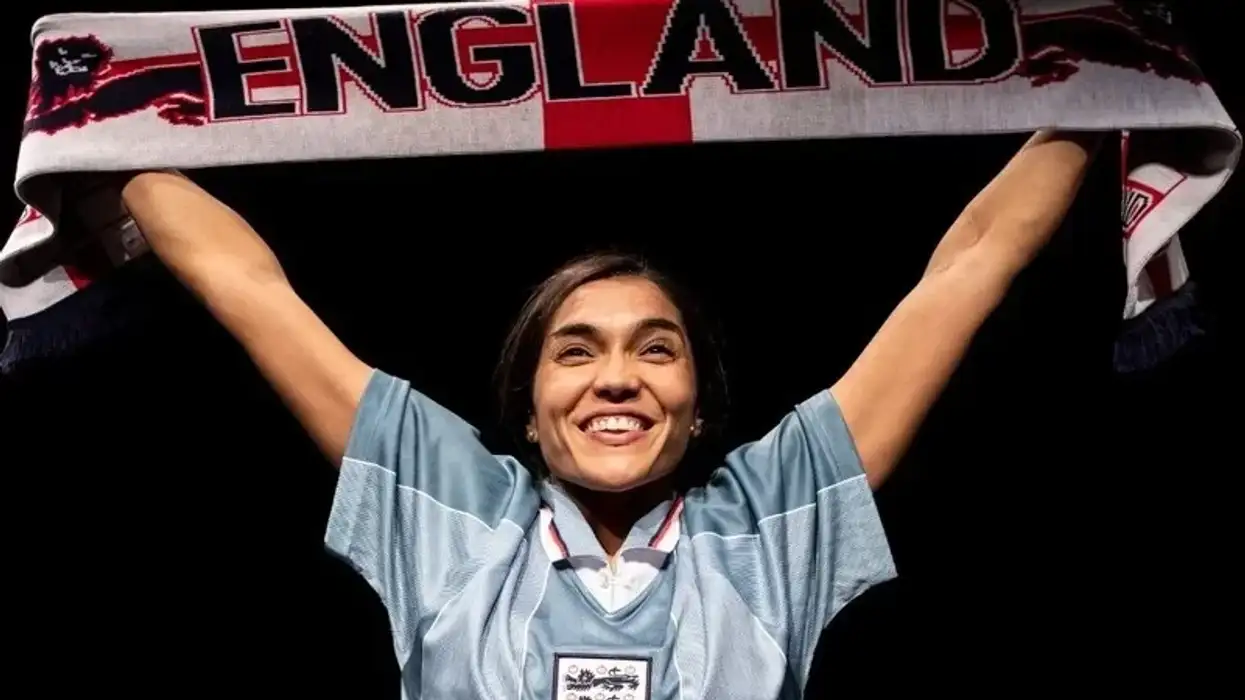

Hannah Kumari brings her smash-hit one woman show, ENG-ER-LAND, to the King’s Head Theatre this month although she has passed on the leading role to Nikhita Lesler.
The play is set in 1997 - a confusing time for the lead character, 14-year old Lizzie. Her mum’s from India, her dad is Scottish whilst she was born in England. All she really wants though is to look like Gwen Stefani.
As her friends turn their back when she needs them most, and her dad’s affection seems to be focused elsewhere, Lizzie starts to question if there's anywhere she really belongs.
ENG-ER-LAND is inspired by Hannah’s personal experiences of going to Coventry City matches in the late 90s and growing up as a mixed-race teenager in a small midlands town. The show blends storytelling, dance and 90s nostalgia to explore themes of belonging, identity, football culture and the age-old question of ‘where is home’.
 Hannah Kumari
“I found it really hard growing up being mixed heritage,” Kumari told Eastern Eye.
“I didn't realise that I found it hard at the time, because when you're a child, back in the 90s, we didn’t have as many conversations as we do now about identity.”
Kumari said whilst the show is not strictly autobiographical, it is inspired by things she has seen or experienced in her life.
“The majority of the play takes a place over the course of one day as Lizzie is on her way to football. We see through the people she encounters and the experiences she has, some of the struggles she faces, like discrimination from her friends or people that her friends know in not being quite accepted within the group for being different,” she said.
“It is very much a personal story, because I was an actor before writing this play, and I'd never written anything before, so it was my kind of personal story dramatised in some places.”
Kumari's mum is from India and came to the UK when she was six whilst her my dad is white Scottish although he was born in the Midlands.
She reveals that she had “quite a white English upbringing”..
“I'm from a small town, Rugby. All my friends were white, but throughout my life, for some people, my upbringing has not matched up with my skin colour.
“I really struggled with feeling like there was a place where I did belong and I was accepted.”
The sense of belonging came in unexpected surroundings - a football stadium.
Hannah’s love of football began when her stepdad came into her life when she was 10-years-old. Whilst he was a die-hard Arsenal fan, she decided to support her local team Coventry City.
Her uncle was also a Coventry City fan and was a season ticket holder.
“I was just hooked from that first game. I was like, ‘this is amazing. I love everything about this’,” she said.
“I later got a season ticket and started to go with my uncle and his friends. I can tell you, there wasn't many 13-year old brown girls going to football in 1996 especially with a group of white men in their 30s.
“On the surface of it, I didn't look like I belonged there, I'm not saying I didn't have any negative experiences, because I definitely did, and I have as an adult woman as well (at football grounds), but in those moments where you're in the crowd with all the people that support the same team as you, you all want the same thing, it is a really special feeling.
“Sharing those big emotions with those people, was something I din't feel like I could share with my own family as I felt quite isolated growing up, and football really offered me a place where I felt more at home - I felt like I was part of something, I felt like I had a community.
“It was also an escape. When you get crazy football games, you just forget about everything else, don't you? I love it because it's so quick and fast, you have to keep your eye on what's going on, because you really never know what's going to happen. And that's why it's so brilliant.”
Kumari is a writer, producer and former actor who manages the Fans For Diversity Campaign alongside Nilesh Chauhan.
The campaign is a partnership between the Football Supporters’ Association (FSA) and Kick It Out. Its aim is to celebrate diversity in football to ensure all fans feel safe and welcome at the game, regardless of; age, disability, gender, race, faith, sexual orientation or any other protected characteristic.
Kumari’s relationship with The FSA began in 2020 when Fans For Diversity, alongside Arts Council England, supported the development and subsequent tour of the original production of ENG-ER-LAND.
The timely return of ENG-ER-LAND follows a recent revealing and shocking documentary from Sky Sports Football’s Hidden Talent which investigates why there are still so few players of south Asian heritage in both the men’s and women’s game, described by some as a ‘football emergency’.
More than four million people with South Asian heritage live in the UK. But only 22 male players out of approximately 3,700 professionals, have south Asian backgrounds and the women’s game faces similar problems.
According to research conducted in 2023 by Kick It Out and the FA, "Asian participants in football are deemed to be most likely to experience discriminatory abuse based on ethnic origin.”
“I wrote ENG-ER-LAND to highlight some of the struggles faced by groups who have traditionally been underrepresented in the stands at football, and to celebrate my lifelong obsession with the game,” she said.
“The play is also an exploration of my mixed heritage identity and the idea of Englishness - what does it mean to be English, who gets to define that, and where does football fit in?”
After performing and touring the show for three years, Kumari passes the ball to Lesler but will continue to produce the show.
“It's really exciting for me now to pass on the play to somebody else, because I have always performed it previously, so this is the first time that I'm not performing it,” she said.
“I've known Nikhita for a couple of years now - she's worked on a couple of other projects that I've been writing. I asked her directly because I thought she was the person to play the part as she's a great actress - I'm really excited to see what she does with it.”
ENG-ER-LAND is running at the King’s Head Theatre, London from 25 July - 10 August.


 Catarina and the beauty of killing fascists Photo credit: Carlos Fernandes
 Photo credit: Carlos Fernandes
