
Skip to content
Search

Latest Stories

Protest at press conference of Rajkumar Santoshi's Gandhi Godse: Ek Yudh

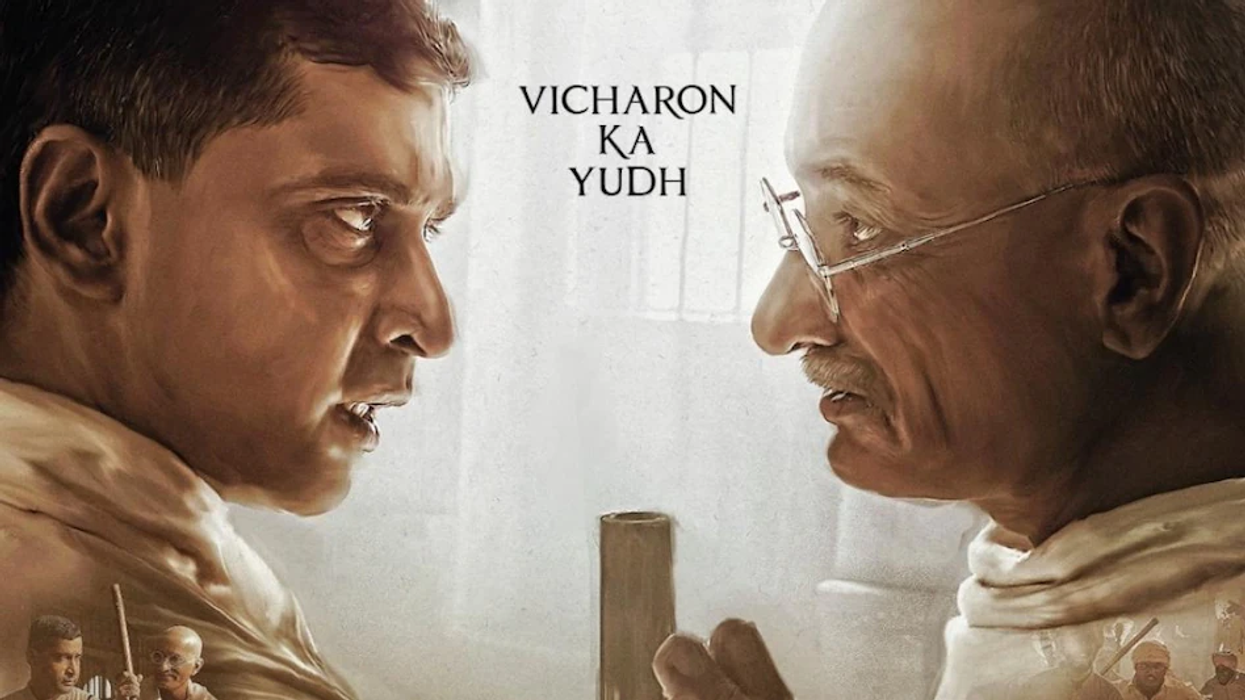
Written and directed by Santoshi, the film depicts the war of the two opposing ideologies between Gandhi and Godse.

Protest at press conference of Rajkumar Santoshi's Gandhi Godse: Ek Yudh

A promotional event for Rajkumar Santoshi's upcoming film "Gandhi Godse: Ek Yudh" was on Friday disrupted by protesters, who claimed the movie undermines the legacy of Mahatma Gandhi and glorifies his assassin, Nathuram Godse.

Written and directed by Santoshi, the film depicts the war of the two opposing ideologies between Gandhi and Godse.


During the press event, the protesters, who sat among the media personnel, waved black flags and shouted slogans like 'Mahatma Gandhi Zindabaad'.

They alleged that through the movie, Santoshi was trying to glorify Nathuram Godse, the man who killed Gandhi on January 30, 1948.

According to a press release issued on behalf of the makers, police were called to avoid any unpleasant situation.

Santoshi said his film does not glorify Godse.

"Once people see the film, they will understand what I am trying to convey through my film. I have equally given importance to both the historical characters in my films," the director said in a statement.

"Gandhi Godse: Ek Yudh" features Deepak Antani and Chinmay Mandlekar as Mahatma Gandhi and Nathuram Godse, respectively.

Backed by Santoshi Productions LLP and PVR Pictures, the film is scheduled to be released on January 26.

(PTI)

More For You

Samir Zaidi

Two Sinners marks Samir Zaidi’s striking directorial debut

Samir Zaidi, director of 'Two Sinners', emerges as a powerful new voice in Indian film

Indian cinema has a long tradition of discovering new storytellers in unexpected places, and one recent voice that has attracted quiet, steady attention is Samir Zaidi. His debut short film Two Sinners has been travelling across international festivals, earning strong praise for its emotional depth and moral complexity. But what makes Zaidi’s trajectory especially compelling is how organically it has unfolded — grounded not in film school training, but in lived observation, patient apprenticeships and a deep belief in the poetry of everyday life.

Zaidi’s relationship with creativity began well before he ever stepped onto a set. “As a child, I was fascinated by small, fleeting things — the way people spoke, the silences between arguments, the patterns of light on the walls,” he reflects. He didn’t yet have the vocabulary for what he was absorbing, but the instinct was already in place. At 13, he turned to poetry, sensing that the act of shaping emotions into words offered a kind of clarity he couldn’t find elsewhere. “I realised creativity wasn’t something external I had to chase; it was a way of processing the world,” he says. “Whether it was writing or filmmaking, it came from the same impulse: to make sense of what I didn’t fully understand.”

Keep ReadingShow less