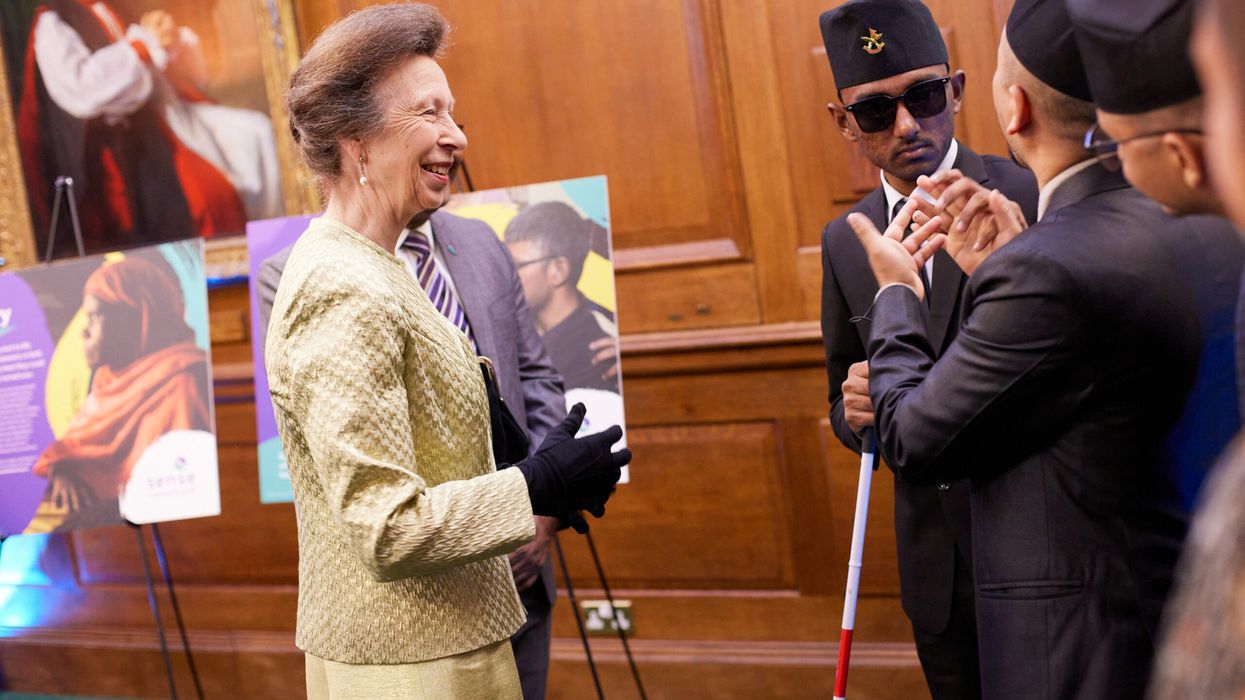

A GALA dinner last week celebrated the 30th anniversary of Sense International, a global charity supporting children and adults with deafblindness.
Her Royal Highness, the Princess Royal, was joined by supporters and beneficiaries from four continents at the milestone event in Westminster last Thursday (26).
Olympian and broadcaster Jeanette Kwakye hosted the event, which featured live music from the International London Choir, Limahl, and the Ronnie Scott Rejects, as well as a fundraising auction led by BBC star Raj Bisram.
Sense International’s work spans south Asia to South America, covering eight countries, including India, Bangladesh, and Kenya, and helping over 80,000 people and their families each year. The Princess Royal has been the charity’s Patron since its founding in 1994.
She highlighted the tremendous progress Sense International has made over the years, noting the significant impact of its programmes across the world. She acknowledged the dedication of those attending the event, including young adults supported by the charity, who shared their personal stories.
Reflecting on her travels, the Princess Royal recounted her visit to Uganda, where she witnessed first-hand the charity’s early childhood development programme and the use of inclusive technologies, such as the modern Orbit Reader for blind children, marking a shift from traditional Braille machines. She also recalled her 2007 visit to Delhi, where Sense International’s advocacy work increased access to education for deafblind children, leading to more inclusive support in primary schools.
Despite these achievements, HRH stressed much work remains to be done. Many children with deafblindness still face barriers to accessing healthcare, education, and employment due to poverty, stigma, and discrimination. However, she emphasised that with the right support, communities can overcome these challenges, enabling children with deafblindness to thrive.
She also called for collective action to make a lasting difference in the lives of children and families affected by deafblindness.
Over the past 30 years, Sense International has made a significant impact on the lives of more than a million children, young people, and adults affected by deafblindness. Established in 1994, the charity aims to share the expertise of its parent organisation, Sense UK, while providing essential services such as early screening, education, and vocational training.
Key milestones in Sense International’s journey include the initiation of the first accredited teacher training programme for deafblindness in India in 1999. In 2005, the charity launched a pioneering programme in Romania that identified deafblind children through sensory screening in maternity wards and early intervention centres. This initiative led to the Romanian government recognising deafblindness as a distinct disability in 2007.
Sense International’s advocacy has prompted several governments, including those of Peru, Tanzania, Bangladesh, Nepal, India, Kenya, and Uganda, to categorise deafblindness as a severe disability requiring support.
Notably, in 2019, Uganda began vaccinating children against rubella, a major cause of deafblindness, reaching 18 million children. Furthermore, in 2020, educational resource classes initiated by the charity received funding from the Nepalese government, ensuring essential support for children in schools.
Over the past 30 years, the charity has reached more than a million children, young people and adults, providing essential services such as early screening, education and vocational training. It works with hospitals, schools, employers and governments to build understanding and awareness of deafblindness and create inclusive communities.
Richard Kramer, chief executive of Sense and Sense International, said, “We are immensely proud of the impact of our work over the past three decades, helping to transform the lives of children, adults and families across the globe.






 Curator Emma Slocombe with ikat robes and arabachi coats in the Peter the Great Room in Blickling Hall Amit Roy
 View of the entrance to Blickling Hall on a rainy autumn dayAmit Roy
 Kente cloth from Ghana in the Long Gallery in Blickling Hall
 Decoration in the Great Hall at Blickling Hall Amit Roy
 Palampore fragment made in coastal south-east India in the Brown Room in Blickling Hall Amit Roy
 Bed valance dating from early 1700s in the Italian Print Room at Blickling Hall Amit Roy
 Indian inspired fabric draped on sofas in the South Drawing Room in Blickling Hall Amit Roy
 Indian inspired fabric draped on sofas in the South Drawing Room with Indian carpet in Blickling Hall Amit Roy
 Karun Thakar has picked out the geometric patterns in the bookcase and the Kente cloth in the Long Gallery in Blickling Hall Amit Roy
 Large tapestry depicting Peter the Great defeating the Swedish army at the Battle of Poltava in 1709 Amit Roy
 ikat robes and arabachi coats in the Peter the Great Room in Blickling Hall Amit Roy
 Baghs and kanthas made by women provide contrast to the men only portraits in the Great Hall at Blickling Hall Amit Roy
 Baghs and kanthas in the entrance Great Hall at Blickling Hall Amit Roy
 Baghs and Kanthas in the Great Hall in harmony with stained glass window at Blickling Hall Amit Roy
 Kimonos reflect Japanese influence in Upper Ante Room in Blickling Hall Amit Roy
 Kimono in Upper Ante Room in Blickling Hall
 A view of the Palace and fort at Agra shows romantic side of India Amit Roy
 Blickling Hall Amit Roy
 Table carpet, European 1670-1680 Amit Roy
 Unfinished 17th century Italian embroidery in the Print Room at Blickling Hall Amit Roy
 Picture of Kashmir shows a romantic view of India Amit Roy
 A panel of Ashburnham bed hangings made in Gujarat for sale in Europe in the Brown Room in Blickling Hall Amit Roy
 Colcha made in the 1600s by women in Bengal for the Portuguese market in the Long Gallery at Blickling Hall Amit Roy