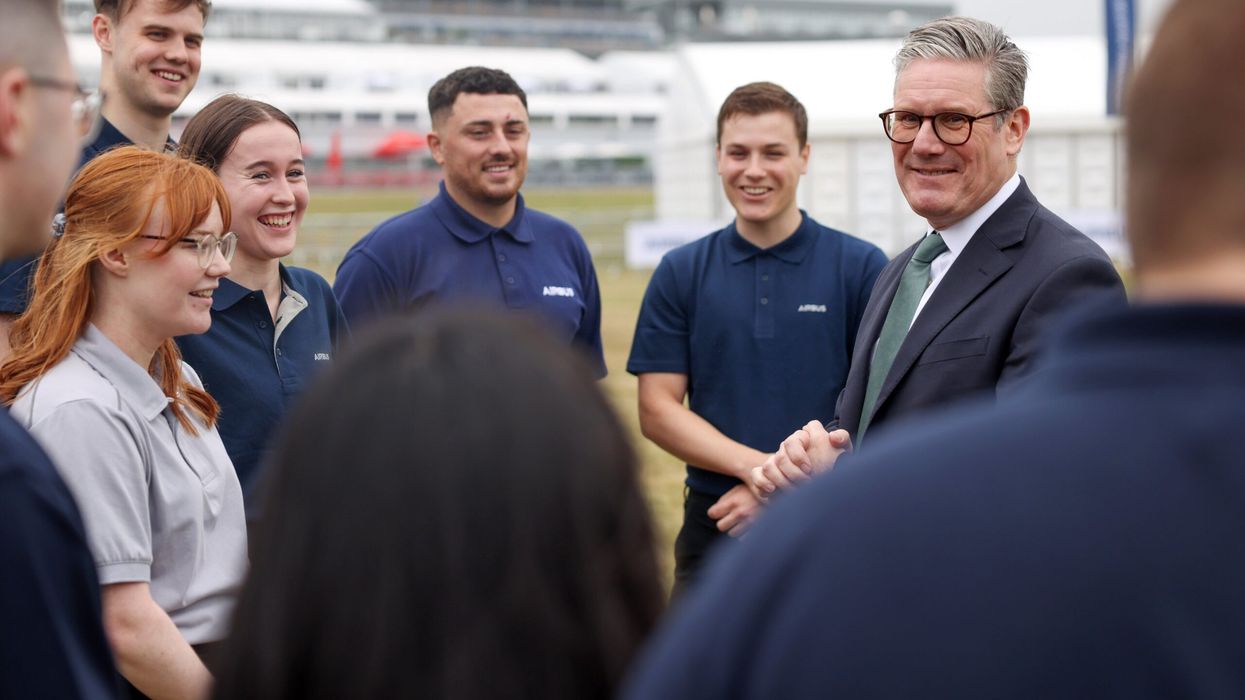

Keir Starmer announced on Monday the creation of Skills England, a new skills training organisation aimed at reducing the UK's reliance on overseas workers. He said that this initiative seeks to boost productivity and economic growth.
Starmer said that Skills England will transform how young people and adults are trained, and improve the relationship between businesses and the education system.
Speaking at the Farnborough International Airshow, the prime minister said that a lack of skills training has left many young people without opportunities, leading to an overreliance on migration within the economy.
"I do not criticise businesses who hire overseas workers and I certainly don't diminish the contribution that migration makes to our economy, to our public services and, of course, to our communities," he said.
"Yet if you stand back, as a system it cannot be right that some people don't get to feel the pride of making a contribution, the dignity of work, just because we can't find a way of creating a coherent skills system."
Starmer stated that his Labour government will not rely solely on importing skills. "We're turning the page on that," he said, pledging to reduce the UK's long-term reliance on overseas workers.
Skills England will collaborate with the Migration Advisory Committee to identify and address current and future skills gaps.
The organisation will involve central and local government, businesses, training providers, and unions, and will provide strategic oversight of the skills system for over-16s.
The education ministry noted that a third of productivity improvement over the last two decades can be attributed to improvements in skill levels.
However, between 2017 and 2022, UK skills shortages doubled to over half a million, accounting for more than a third of job vacancies.
Net migration levels, the difference between those entering and leaving the country, have increased significantly in recent years, reaching a record 764,000 in 2022. Last year it was 685,000, driven by non-EU citizens.
"It is right that we get migration down," Starmer said. "It's too high. That's why Skills England will be working on this issue to make sure that we have the skills in place to bring those levels down."
(With inputs from AFP)