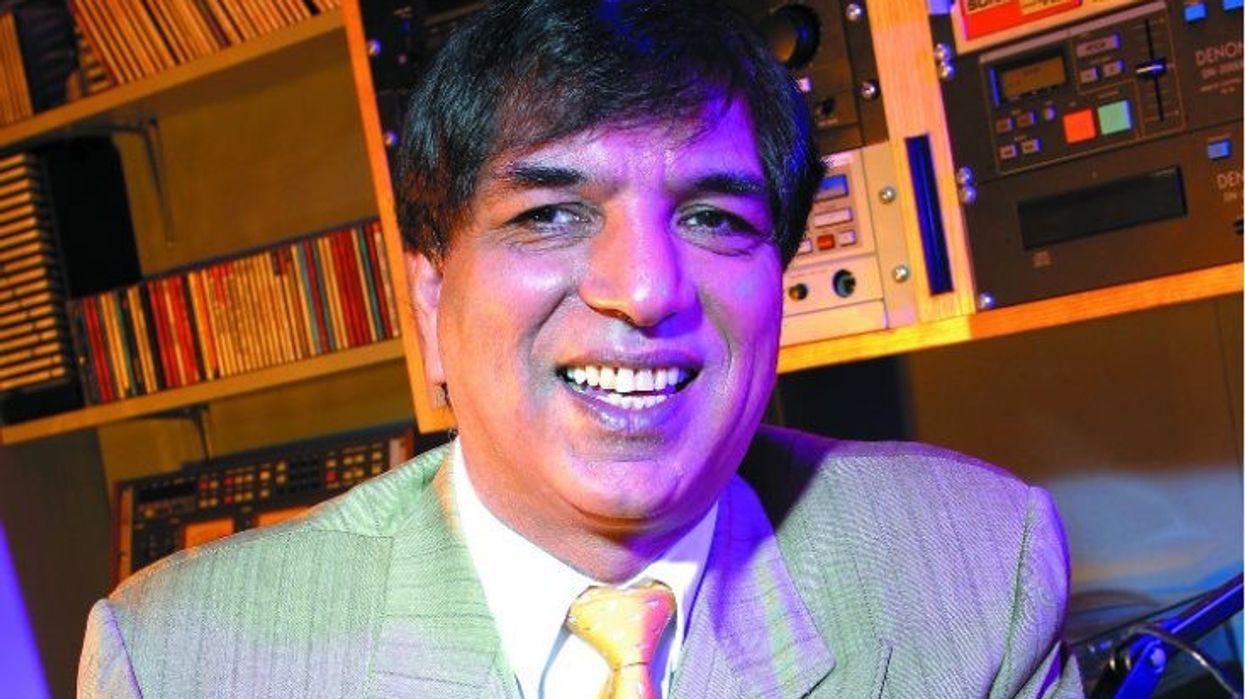

WARM tributes have been paid to Avtar Singh Lit, who challenged the broadcasting rules of his day when he set up Sunrise Radio in 1989 and was unfairly labelled a “pirate” by the authorities. His death on Tuesday (27) in his 70s was announced by the station which described him as a “pioneer” in the field of Asian radio. “We are incredibly proud of his legacy which has given much joy and opportunity to so many.
Avtar is survived by his mother, five children – Surjit (51), Tony (50), Bobby (49), Serena (24), and Robbie (19) – and his five grandchildren. He was
a much-beloved son, father, and grandfather,” it added.
Lit was born in Punjab, came to Britain in 1962, and, according to his CV in Jasbir Singh Sachar’s Asian Who’s Who went to secondary school in Kent before entering the Royal Navy College in Chatham. He dabbled, sometimes controversially, in a variety of businesses, and got involved in the management of Sunrise Radio. But he always maintained his real love was broadcasting. And it was at Sunrise Radio that he provided the first break to many young people who later found jobs with the BBC Asian Network.
He was a familiar and flamboyant figure in Southall, entertained frequently at the spacious home he bought in Osterley, and drove around in a Rolls-Royce with a personalised number plate. He presented a phone-in programme on Sunrise for many years and was not afraid to wade into the complex Punjabi politics of Southall. He also had a large stock of entertaining anecdotes.
On a trip to India, he said he was offended when a visa officer at the British High Commission in Delhi refused to give clearance to someone Lit was trying to sponsor for a visit to the UK. True or not, Lit said he reprimanded the officer: “You talk big for someone on £20,000 a year.”
Lit was not prepared to leave the matter without further intervention. Discovering the officer was due to fly to the UK on home leave, Lit claimed he had a quiet word with a contact in the airline concerned, with the result “the man was off-loaded before the flight took off for London”.
Lit had a love-hate relationship with Piara Singh Khabra, who was Virendra Sharma’s predecessor as the Labour MP for Southall. Lit stood unsuccessfully as an independent parliamentary candidate against Khabra in 2001, but maintained cordial relations with the MP until his death in 2007.
“He used to come home for dinner,” said Lit. “He had a wicked sense of humour and we did laugh together. He was the last of the old-style, first-generation community leaders. He helped to develop the Indian Workers’ Association. He packed the membership of the local Labour party and gained control.”
In the by-election in 2007, triggered by Khabra’s death, Lit’s son Tony, stood as the Tory candidate with his father’s blessing. He came third with 8,230 votes (22.5 per cent) against Sharma’s winning 15,188 (41.3 per cent).
Lit was not above amusing himself by causing mischief, as he admitted he did in 1995 when many Hindus in the UK, India and elsewhere believed their deities were drinking milk. Lit said in the Sunrise Radio washroom, he had chanced across an old report in an Indian newspaper of a deity drinking milk in a temple. He decided to recreate the phenomenon in Southall.
“So, coming out from the washroom, I summoned Ravi Sharma, a former priest and now a very famous broadcaster, to my office,” Lit later confided to Eastern Eye. “Within three minutes of his arrival in my office, Ravi was chasing the priest at Lady Margaret Road Mandir in Southall and, having got through to him on the telephone, the priest was requested to offer milk to the gods while we stayed on the telephone. A few minutes later the priest reported God was drinking the milk.
“I dispatched a reporter from the newsroom along with Ravi Sharma to go to the mandir [temple] and report back to me once they verified the gods were drinking milk. And they did, so I wrote up the script and sent it to my newsroom to carry it as the last item on the 2pm news.
“I did pause before I instructed the news department to carry it because I knew what was likely to happen across Britain in the next three or four hours in
the Hindu and Sikh community. By 3pm it became top story on Sunrise News. By 4pm Southall shops ran out of milk and long queues started to form outside the mandir. By 4.30pm Sunrise Radio start receiving phone calls from other mandirs in the UK and Europe as they jumped on the bandwagon that their gods were also drinking milk. No self-respecting priest or a committee member of a mandir wanted to be left behind.
“By 5pm, queues were getting longer outside the mandirs and the milk shortage was getting greater in west London and shopkeepers had cottoned on and upped the prices. “BBC, ITV and Sky News dispatched their outside broadcast units to broadcast live from outside Sunrise Radio and the mandir. The following day, Fleet Street descended on Southall and the story dominated the news across the world for the next 72 hours. On the Sunday, David Frost’s programme went live from Southall. The rest is history.”
Lit laughed as he said: “On reflection, I think that we need more such miracles in the UK.”

 The announcement comes as entertainment companies increasingly explore how artificial intelligence can be integrated ZEE5