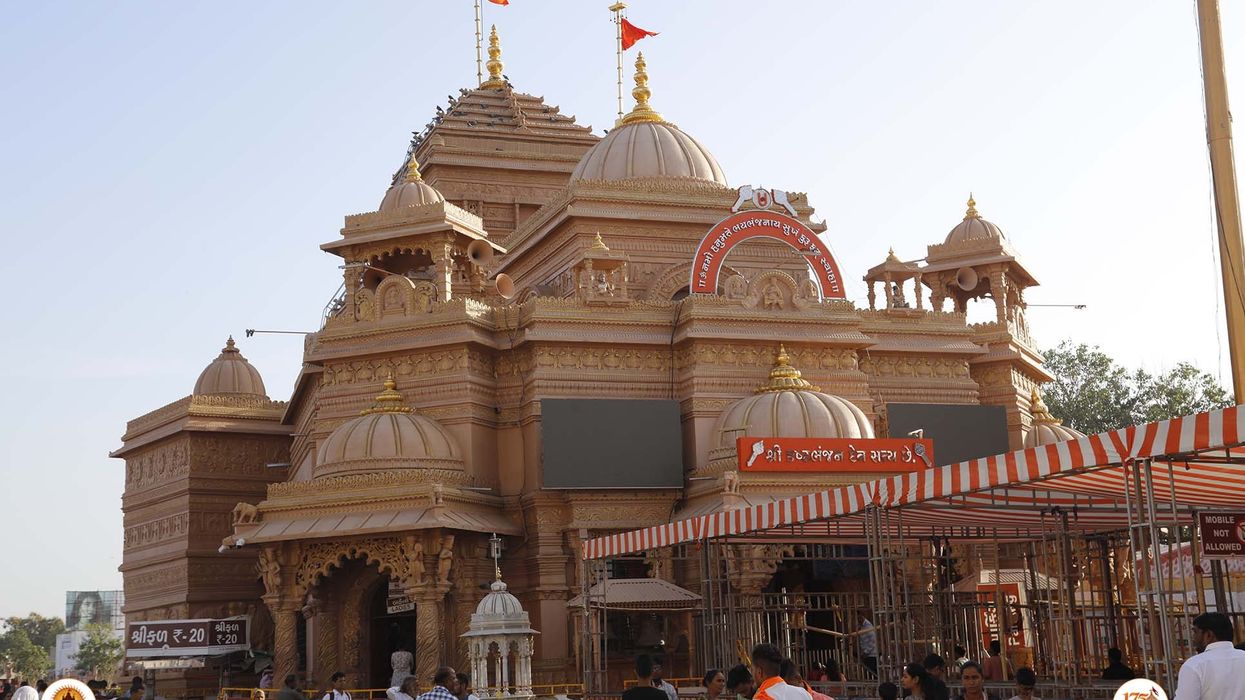

The Salangpur Temple controversy that was caused by murals that depicted Lord Hanuman at the feet of yogi and ascetic Swaminarayan, came to an end as the temple administration initiated the removal of the Lord Hanuman murals in the early morning hours on Tuesday.
After several days of controversy surrounding the contentious murals of Lord Hanuman at a Swaminarayan sect temple in Gujarat's Botad district, the temple's management revealed their decision to remove the murals by Tuesday.
This particular temple, widely recognised as Salangpur Hanuman Mandir, holds immense sanctity among the Swaminarayan sect's adherents and is considered "the most holy and sacred" among Swaminarayan sect's followers.
The decision to remove the murals evolved following numerous rounds of meetings involving religious leaders from diverse organisations, such as the Vishwa Hindu Parishad and the Rashtriya Swayamsevak Sangh.
Reports indicate that an additional meeting took place at chief minister Bhupendra Patel's residence in Gandhinagar, focusing on finding a resolution to the ongoing controversy.
Subsequently, a meeting was assembled at Shivanand Ashram, where the temple's management resolved to eliminate the murals before Tuesday's sunrise.
On Monday (4) representatives of the Swaminarayan sect, alongside other Hindu saints, convened in Ahmedabad and reached a consensus to remove the disputed murals. This meeting was orchestrated by the Vishva Hindu Parishad (VHP).
The Shri Kashtbhanjan Temple, where the controversy emerged, is situated in Sarangpur, within Gujarat's Botad district.
One of the branches of the prominent Swaminarayan sect, known as Vadtal Gadi Sansthan, oversees the administration of the temple.
Allegations were made that the murals portraying Lord Hanuman were deemed disrespectful.
The contentious murals were introduced as part of the temple premises' renovation and embellishment efforts.
A towering 54-feet idol of Lord Hanuman had been installed, surrounded by these now-controversial murals.
The process of removing the murals was set into motion late on Monday. The temple's surroundings were enveloped in darkness as the lights were extinguished, and curtains were drawn around the murals, all under stringent police security.
Subsequently, new murals were installed to replace the disputed ones.
The controversy over the murals depicting Lord Hanuman in Salangpur erupted on Saturday (2). These murals depicted the Hindu deity as a devoted servant of Sahajanand Swami, eliciting strong opposition on social media platforms.
Consequently, several prominent Hindu saints and mahants, including Morari Bapu, renowned saint Harshad Bharti Bapu, and Mahant Manidhar Bapu of Kabrau Mughal Dham in Kutch, publicly voiced their discontent.
The Swaminarayan sect, characterised by its various factions, reveres Sahajanand Swami (1781-1830) as Lord Swaminarayan, around whom the sect revolves.
The Hanuman temple in Salangpur, features an imposing statue of Hanumanji. On the statue's base, numerous murals were created.
However, the murals portrayed Hanumanji as an ardent disciple of Sahajananda Swami. In these murals, Hanumanji stood before Sahajananda Swami, displaying profound reverence with folded hands in a salutation pose.
Another mural depicted Hanumanji seated in an asana, once again with hands folded in a gesture of profound respect.
Controversy ensued when images of these murals gained widespread circulation.