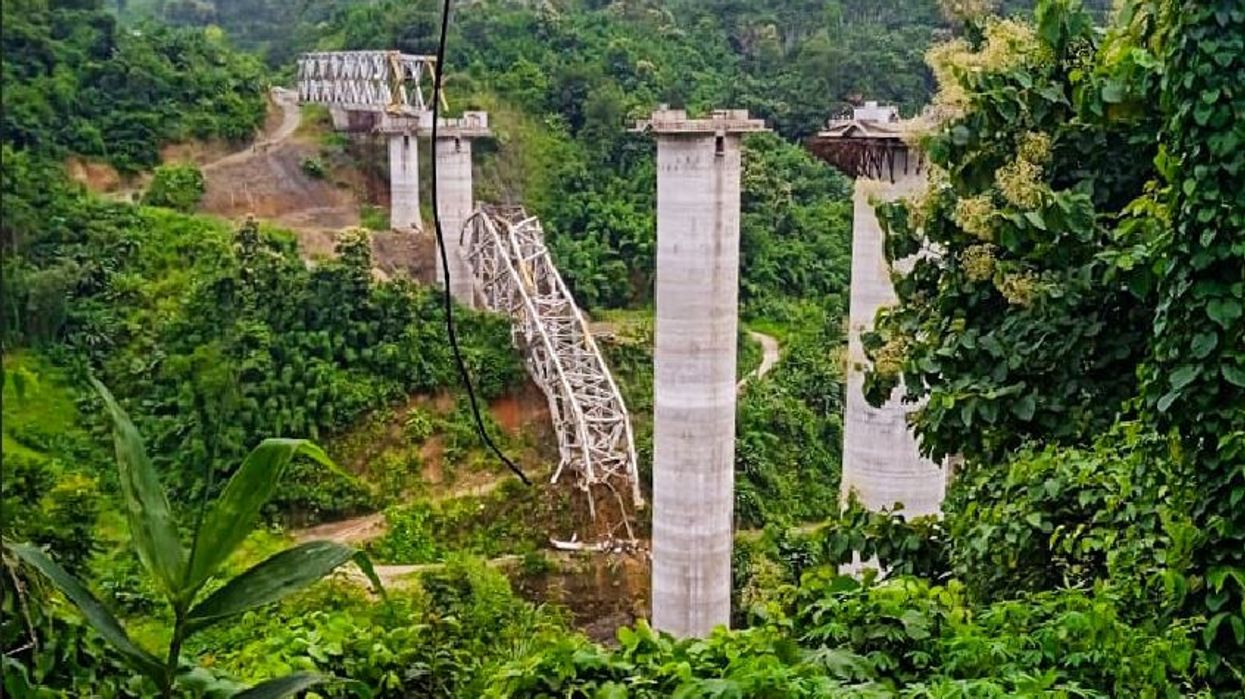

AT LEAST labourers working on a railway bridge being built across a ravine in India's eastern Mizoram state were killed when it collapsed on Wednesday (23), officials said, with others reported missing.
Video footage posted by Mizoram chief minister Zoramthanga showed a metal frame that had toppled off towering columns into a wooded valley below.
"Under construction railway over bridge at Sairang, near Aizawl collapsed today; at least 17 workers died," Zoramthanga, who uses only one name, said on X, formerly known as Twitter.
The Indian Express newspaper quoted a policeman as saying that 17 bodies had been recovered and "many others" were missing. It was not possible to immediately verify the reports of people missing.
The Hindu newspaper, quoting state government officials, reported some 40 workers had been at the site when the bridge collapsed.
"Rescue operations are underway and all possible assistance is being given to those affected," the office of prime minister Narendra Modi said.
Modi was "pained" by the accident and offered his "condolences to those who have lost their loved ones", his office said on X.
The government will pay some $2,400 to the next of kin of those killed, it said.
Mizoram is in the far east of India, bordering Myanmar.
People had "come out in large numbers to help with rescue", Zoramthanga said, adding he was "deeply saddened and affected by this tragedy".
Accidents on large infrastructure construction sites are common in India.
At least 20 workers were crushed to death in western India this month when a crane collapsed above an under-construction expressway outside the financial capital Mumbai.
In October last year, 130 people were killed in Gujarat when a bridge collapsed soon after it was repaired.
And in 2016, the collapse of a flyover onto a busy street in Kolkata killed at least 26 people.
(AFP)






 Curator Emma Slocombe with ikat robes and arabachi coats in the Peter the Great Room in Blickling Hall Amit Roy
 View of the entrance to Blickling Hall on a rainy autumn dayAmit Roy
 Kente cloth from Ghana in the Long Gallery in Blickling Hall
 Decoration in the Great Hall at Blickling Hall Amit Roy
 Palampore fragment made in coastal south-east India in the Brown Room in Blickling Hall Amit Roy
 Bed valance dating from early 1700s in the Italian Print Room at Blickling Hall Amit Roy
 Indian inspired fabric draped on sofas in the South Drawing Room in Blickling Hall Amit Roy
 Indian inspired fabric draped on sofas in the South Drawing Room with Indian carpet in Blickling Hall Amit Roy
 Karun Thakar has picked out the geometric patterns in the bookcase and the Kente cloth in the Long Gallery in Blickling Hall Amit Roy
 Large tapestry depicting Peter the Great defeating the Swedish army at the Battle of Poltava in 1709 Amit Roy
 ikat robes and arabachi coats in the Peter the Great Room in Blickling Hall Amit Roy
 Baghs and kanthas made by women provide contrast to the men only portraits in the Great Hall at Blickling Hall Amit Roy
 Baghs and kanthas in the entrance Great Hall at Blickling Hall Amit Roy
 Baghs and Kanthas in the Great Hall in harmony with stained glass window at Blickling Hall Amit Roy
 Kimonos reflect Japanese influence in Upper Ante Room in Blickling Hall Amit Roy
 Kimono in Upper Ante Room in Blickling Hall
 A view of the Palace and fort at Agra shows romantic side of India Amit Roy
 Blickling Hall Amit Roy
 Table carpet, European 1670-1680 Amit Roy
 Unfinished 17th century Italian embroidery in the Print Room at Blickling Hall Amit Roy
 Picture of Kashmir shows a romantic view of India Amit Roy
 A panel of Ashburnham bed hangings made in Gujarat for sale in Europe in the Brown Room in Blickling Hall Amit Roy
 Colcha made in the 1600s by women in Bengal for the Portuguese market in the Long Gallery at Blickling Hall Amit Roy




